


Karma Automotive validates solid-state battery cells from Factorial
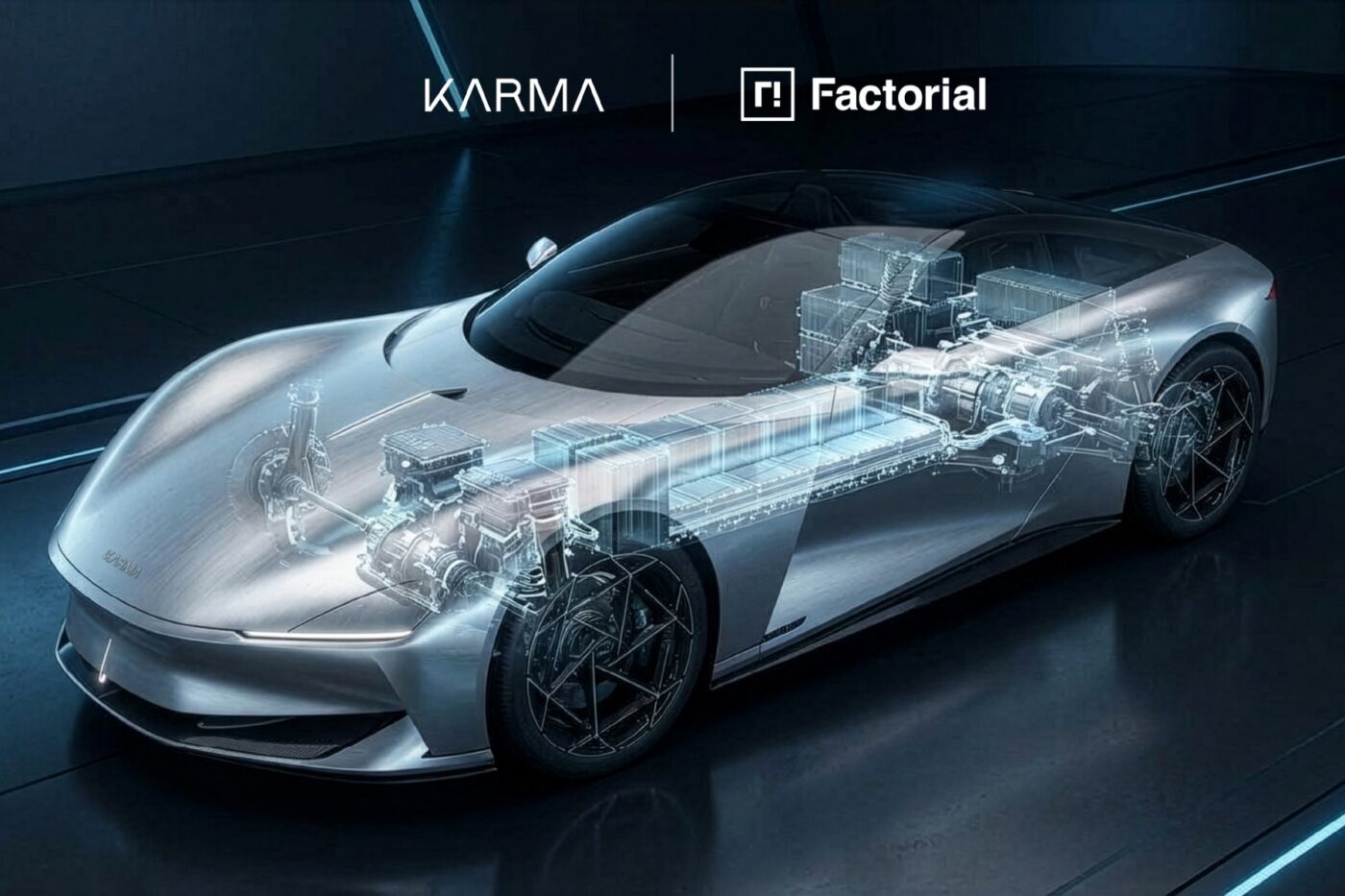
Karma Automotive and Factorial have announced a joint passenger vehicle production programme for solid-state batteries. The plan is to integrate Factorial’s technology into Karma’s platform, with the goal of validating the solid-state battery solution ‘in a production passenger vehicle environment.’ The partners have already identified their first vehicle for this technology: the Karma Kaveya, a super sports car planned for 2027, which will boast over 735 kW of power and a top speed of more than 320 km/h.
Both companies will focus on Factorial’s technology, known as ‘FEST’ (Factorial Electrolyte System Technology). This technology is based on a lithium-metal anode and a polymer separator. In June 2024, B-samples of these solid-state cells, with a charging capacity of over 106 Ah, were already circulated. These cells are reported to achieve an energy density of 391 Wh/kg—though the developer did not specify whether this refers to cell or system level. Stellantis has since validated the FEST cells.
Factorial Energy is a US-based specialist in solid-state battery cells, primarily backed by Mercedes-Benz, Stellantis, and Hyundai-Kia. In addition to its FEST technology, the company is pursuing further development strands. For instance, it is collaborating with Mercedes on cells under the brand name Solstice. These are currently only at the A-sample stage but promise even higher energy density and a dry cathode coating process. In September 2024, Factorial announced an energy density of up to 450 Wh/kg for its Solstice product (again, without specifying whether this refers to cell or pack level), which could increase the range of electric vehicles by up to 80 percent. The company also recently reported a breakthrough, having achieved a charging capacity of 40 Ah for this cell type.
Returning to the collaboration with Karma, which is based on the FEST technology: Factorial states that this technology is designed to be integrated into existing lithium-ion battery factories. “Rather than relying on new production lines, Factorial’s FEST cells can work with up to 80 per cent of existing lithium-ion manufacturing equipment,” the company explains. This is expected to enable rapid scaling of Factorial’s commercial production programme with Karma Automotive.
“Karma Automotive was imagined to push the boundaries of what the ultra-luxury vehicle experience can be, and Kaveya is the vehicle that re-introduced Karma to the market in November 2023,” said Marques McCammon, President and Chief Executive, Karma Automotive. “However, in 2025 we delayed launch because we did not yet see a clear path to fully delivering the uncompromising driving experience that should be expected from an American ultra-luxury vehicle company. Now through the partnership with Factorial and the integration of FEST®, we cannot only deliver that experience, but also open a pathway to stronger, more stable electrified drive systems for Karma owners and the broader industry.”
Siyu Huang, CEO of Factorial, added: “Launching our first U.S. passenger-vehicle program with Karma is a meaningful milestone for Factorial. was built to scale, and this milestone not only highlights the energy and performance solid-state technology can deliver but also underscores the global leadership of U.S. technology innovators. High-performance luxury vehicles require cutting-edge innovation, and this collaboration showcases what’s possible when performance leads.”
Karma Automotive was founded in 2014 and is both a manufacturer of electrified luxury vehicles and a B2B service provider. Headquartered in Irvine, California, with a production facility in Moreno Valley, the company has faced challenges in the past. In 2020, rumours emerged about liquidity issues, as well as a legal dispute with Lordstown over the theft of intellectual property. Since then, the company has kept a lower profile. Karma now also describes itself as a pioneer in extended-range electric vehicles. For this year, the Gyesera Hybrid EREV four-seater and the Amaris Hybrid EREV coupé remain in the launch pipeline.
0 Comments