


German government to review e-bus funding outcomes ahead of fresh subsidy round
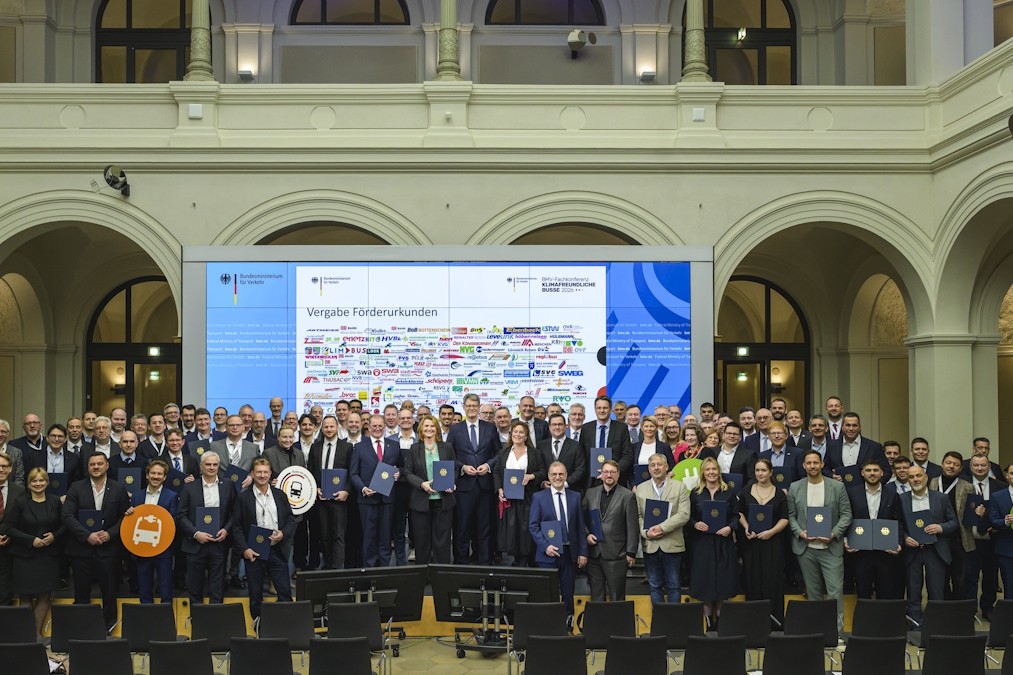
This week, Germany’s bus industry is once again convening in Berlin. Following an initial kick-off conference in 2024, the Federal Ministry of Transport is hosting the second specialist conference on climate-friendly buses, known as BUSKON 2026. The tone of the conference was set this morning by Federal Transport Minister Patrick Schnieder (CDU) in his opening speech.
In his address, Schnieder described battery-electric buses as a cornerstone of climate-friendly local public transport. “With our funding, transport companies are investing in clean, quiet, and innovative technologies. More than 2,200 battery-electric buses supported by our programme are already in operation. […] Around 1,900 additional e-buses will now be added. This demonstrates that the transition is underway—and it brings benefits for passengers and residents, as well as for the climate and the environment.”
Schnieder also drew attention to the announcement of a new funding round: “We are currently working at full speed on a new funding guideline and plan to launch a new funding call as early as spring,” the minister stated. “We have significant resources available again in the 2026 budget. These will enable funding at least at the previous level, amounting to up to €500 million.” His ministry is committed to ‘continuing this success story and achieving our ambitious goals.’ By 2030, the federal government aims to ensure that half of all city buses in operation are battery-electric.
Details about the planned new funding round remain limited. What is clear, however, is that the ‘Guideline for the Promotion of Alternative Drives for Buses in Passenger Transport’, which has been in place since 2021 as the foundation for subsidies, expired at the turn of the year. For the new subsidy round, Schnieder’s ministry requires a new funding guideline—currently under review, as Nikolaus Oberkandler, Head of the Electromobility and Charging Infrastructure Department at the Federal Ministry of Transport, announced at the conference.
Oberkandler assured attendees, however, that applicants should not expect major changes: “We have a programme that works, is well received by transport companies, and is well supported by manufacturers. We do not aim to overhaul it. Instead, we want to operate within the existing framework.” Adjustments may be made to price caps and funding rates, however, to ‘broaden the reach of the funding’. In other words, to support more applications with smaller funding amounts. While the 2026 funding call is largely set at up to €500 million euros, Oberkandler noted that there is no guarantee the programme ‘will continue in this form indefinitely’ due to the strained budget situation.
For now, the message to the assembled transport companies is clear: funding will be available again in 2026—most likely continuing to support battery-electric and fuel cell buses, as well as the necessary charging and refuelling infrastructure, and potentially conversions from diesel to electric powertrains.
The Federal Ministry of Transport also provided a review of the most recent funding round at BUSKON. This round was initiated by the new black-red coalition government in summer 2025, marking the end of a long hiatus (triggered by the 2023 KTF ruling and the subsequent budget gap). The results: in this final round under the ‘old’ funding guideline, 151 companies received a total of €417 million. This funding supports the procurement of 1,887 new battery-electric buses. Schnieder personally handed over almost 100 approval notices to representatives of the funded companies that morning.
Among the funding recipients who came close to the maximum funding cap of €15 million per applicant were companies such as Autokraft, DB Regio Bus Mitte, Duisburger Verkehrsgesellschaft, and LOOK Busreisen. These players are procuring around 60 to 70 new vehicles with the funding. At the other end of the spectrum, however, many small operators received funding amounts of less than one million euros for the procurement of just a handful of e-buses. The complete list of all funding recipients is linked at the end of the text.
“Interest in this funding call was enormous; it was oversubscribed several times,” Schnieder explained on stage. “Based on the applications we received, we could have easily funded more than 5,000 buses.” In the end, nearly 1,900 units were subsidised.
Overall, the Federal Ministry of Transport has supported the transformation in this sector with around 1.5 billion euros since 2021. As a result, approximately 2,200 battery-electric buses have already been deployed, and around 3,000 units have been ordered, as Oliver Braune, Programme Coordinator for Electromobility and Buses in Department G23 of the Federal Ministry of Transport, detailed in his presentation. The procured buses are expected to have collectively covered 120 million kilometres. Additionally, the funding supported the procurement of around 2,000 charging stations, two hydrogen refuelling stations, and approximately 100 feasibility studies.
Braune also highlighted the following interim conclusions:
- The initial focus of the funding on large, municipal transport companies was expanded to include private companies. The share of municipal and private companies in the funding is now almost balanced.
- The diversity of manufacturers in the electric bus sector has grown from 7-8 to 14-15 players over the past five years.
- As a result, the variety of models has increased from around 14 to 20-30 models.
- Battery capacity in buses has increased by 60 per cent compared to 2020.
- Daily mileage has risen from 133 to 182 kilometres since 2020.
- Vehicle efficiency has improved by 6.5-9.5 per cent over the same period.
- Prices for e-buses have not decreased over the past five years. Around 55 percent of buses exceed the funding limits.
In general, battery-electric buses accounted for around 25 per cent of new registrations in Germany over the past twelve months. The Federal Ministry of Transport currently estimates the total number of battery-electric buses in operation at 5,700, though not all of these were subsidised. According to Braune, the funding guideline has contributed to around 40 percent of this growth.
Source: Livestream BUSKON 2026, bmv.de (press release), bmv.de (list of funding recipients for the current round), bmv.de (list of all funding recipients under the previous guideline)
0 Comments