


Donut Lab releases second test series on disputed solid-state battery
VTT, the Finnish state research institute, also conducted the second test series. The ‘Donut Lab Solid-State Battery V1 High Temperature Performance Test’ marks VTT’s second publication on Donut Lab’s solid-state cell, intended to validate the cell’s properties through independent investigations. Donut Lab unveiled the allegedly production-ready solid-state cell at CES in January but disclosed only a few key data points and no further details about the claimed breakthrough in battery technology. The company is now providing additional information through the staged ‘I Donut Believe’ campaign and the associated VTT tests.
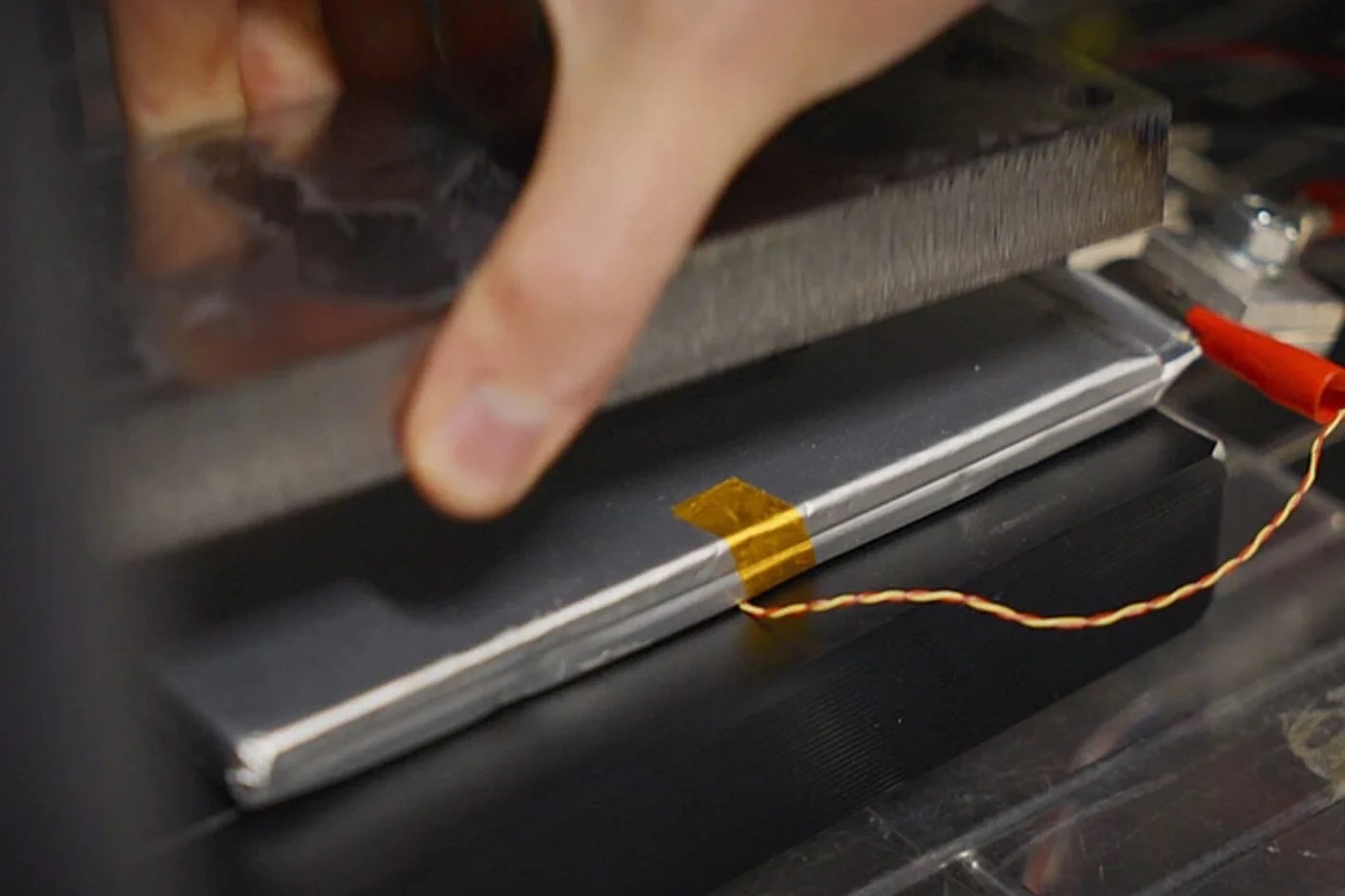
Let us first examine the test setup for the high-temperature performance assessment and the results. VTT tested a Donut Lab cell with a nominal capacity of 26 Ah and a nominal energy content of 94 Wh, according to the datasheet, in a Weiss LabEvent T/110/40/3 climate chamber using a PEC ACT0550 cell tester. Unlike the first test series, the results of which were published last week, VTT placed a 2.4-kilogram steel weight on the cell this time to apply mechanical pressure. The temperature sensor, critical for the high-temperature tests, was positioned underneath the cell between the cell and the aluminium heat sink used in the first test.
The test series comprised three charge-discharge cycles. Initially, at 20 degrees Celsius in the climate chamber (after a one-hour stabilisation period), VTT charged the cell at a constant current of 24 amperes until it reached 4.15 volts. Charging then continued at 4.15 volts until the current dropped to 1.2 amperes, or 0.05 C. For the first test, VTT discharged the cell after one hour at a constant 14 amperes until the voltage fell to 2.7 volts. This procedure determined a capacity of 24.9 Ah for the cell.
Donut Lab cites high-temperature test as proof of heat resistance
After fully recharging the cell using the standard procedure outlined above, VTT increased the temperature in the climate chamber to 80 degrees Celsius and maintained it at that level for two hours. At 80 degrees, the institute discharged the cell at 24 amperes down to 2.7 volts to determine its capacity under elevated temperature conditions.
Following a one-hour stabilisation period at 20 degrees Celsius, VTT recharged the cell and held it at full charge for one hour. It then conducted a reference discharge at 20 degrees with a current of 12 amperes down to a cell voltage of 2.7 volts.
For the third test, VTT heated a fully charged cell under the same experimental set-up to 100 degrees Celsius and kept it at that temperature for two hours. It subsequently discharged the cell at 12 amperes down to 2.7 volts. The institute then reduced the temperature back to 20 degrees Celsius and, after one hour, recharged the cell completely.
Detailed measurement data are available in the VTT report linked below.
“Under the specified conditions, the cell was successfully discharged at +80 °C with a current of 24 A, achieving a discharge capacity corresponding to 110.5 % of the initial discharge capacity at +20 °C with the same current. After discharge, the cell could be charged normally, and no observable changes were detected,” VTT writes. “The cell was also discharged at +100 °C with a current of 12 A, achieving 107.1 % of the reference discharge capacity measured at +20 °C with the same current. After discharge, the cell could be charged normally.”
Donut Lab states: “The test measuring battery performance at high temperatures has shown that the Donut battery is extremely heat-resistant and even delivers improved performance at elevated temperatures.”
“The full capacity of the battery was utilised at both 80 and 100 degrees Celsius with excellent results. Discharge at a 1C rate at 80 degrees and at a 0.5C rate at 100 degrees was possible without any temperature increase,” added Ville Piippo, CTO of Donut Lab. “The battery characteristics remained unchanged even at 100 degrees, and after recharging it functioned flawlessly, confirming the convincing performance of the Donut battery even under extremely hot conditions. This demonstrates that the battery is exceptional not only in terms of performance but also in safety.”
However, VTT notes in its report that the pouch cell labelled DL2 (the first publication’s tests used cell DL3) lost its vacuum after the 100-degree test. What would normally be considered damage, Donut Lab presents as a success: “The battery and its active materials remained fully functional even after the outer cell casing lost its vacuum at 100 degrees.”
“Conventional lithium-ion batteries are highly sensitive to heat and their maximum operating temperature typically lies around 60 to 70 degrees Celsius. At high temperatures, the risk of cell damage increases, reducing service life,” said CTO Piippo. “In addition, high temperatures can accelerate reactions inside the cell and, in the worst case, significantly increase the risk of thermal runaway. The Donut battery starts from a fundamentally different position, as it contains no flammable liquid electrolytes, and therefore the maximum operating temperature is higher.”
Another caveat: VTT does not confirm whether the tested cell is indeed a solid-state cell without lithium. As in the first report, the second states that VTT conducted tests on an ‘energy storage device provided by the customer […] identified by the customer as a solid-state battery cell.’
After the first test series was published, several experts publicly challenged the claim that the cell operates without lithium. Specialists pointed out that the charging curve and additional data indicated it could in fact be a lithium-ion cell.
Joachim Sann, a battery researcher at the University of Giessen, criticised elements of the test procedures defined by Donut Lab, including the approach used to determine capacity and the selected temperature levels.
In another example of the critical response, English-language battery researcher and YouTuber Ryan Inis Hughes revised his initial assessment of Donut Lab’s solid-state cell following the publication of the first results. While in January he had assigned a one per cent probability to the accuracy of Donut Lab’s claims, he now estimates the likelihood at 0.1 per cent based on the available test data.
At present, only one conclusion appears certain: the debate within the specialist community will continue in response to the second test series. Even comprehensive publications by Donut Lab are unlikely to provide definitive clarity. Independent tests examining the cell chemistry itself will ultimately be required.
Source: Information via e-mail (statement), idonutbelieve.com, r2.dev (VTT report; PDF)



0 Comments