


‘Constant’ physical pressure could ‘double’ battery lifespan, new study finds
The research team recently published their findings under the title ‘The interplay between stack pressure, mechanical expansion and degradation pathways in lithium-ion batteries’ in the journal Nature Energy. Their results suggest that battery lifespan could potentially be doubled if pressure is kept within a precise optimal range.
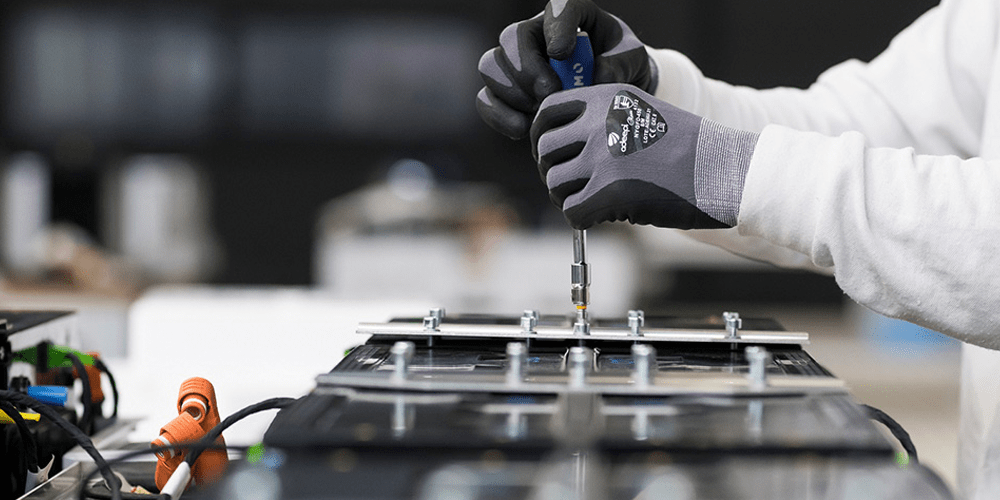
For their experiments, the researchers used a specialised device to maintain pressure on the battery within the optimal range. The team compressed a pouch cell using pneumatic bellows – small air-filled cushions that acted like a clamp. This apparatus maintained constant pressure while a sensor monitored minute volume changes during the battery’s charging and discharging cycles.
Background: Lithium-ion batteries consist of an anode, a cathode, and an electrolyte. During each charge and discharge cycle, lithium ions move from the anode to the cathode and back again. This causes the battery to physically expand and contract – “almost like breathing,” explains Professor Michael De Volder from the Department of Engineering at the University of Cambridge, who co-led the research. However, “batteries don’t tend to like this cycle of stress and release.”
De Volder, a mechanical engineer, elaborates that while much of the work to improve lithium-ion batteries is carried out by chemists and physicists, he wanted to investigate the role mechanics play: “We just bought commercial batteries and tested them for lifetime under different pressures. We didn’t have to change anything about their electrolyte or electrode composition.”
The project team found that the bellows pressure must be around 12.5 bar to positively impact battery lifespan. This corresponds to roughly four times the standard value of conventional button cell batteries, according to the researchers. Outside this range, batteries degraded more quickly: “If the pressure is too high, it can cause lithium plating to form on the anode, and too little can cause the cathode to crack.”
The scientists observed that it is far better for overall battery lifespan “if the pressure is kept relatively constant during each charge and discharge cycle,” states De Volder. “If you press too hard, the anode is unhappy. If you don’t press hard enough, the cathode starts degrading. Our experiments identified where the ‘happy place’ is for batteries when it comes to pressure.”
However, the results are still in their early stages. The technology has so far been tested only at laboratory scale by De Volder and his team and would need to be scaled for commercial battery applications. A patent has already been filed by Cambridge Enterprise, the university’s innovation arm. The research was partially supported by the European Research Council, the Faraday Institution, and the Engineering and Physical Sciences Research Council (EPSRC), part of UK Research and Innovation (UKRI).



0 Comments