


Average price of electric cars falls for first time since 2020
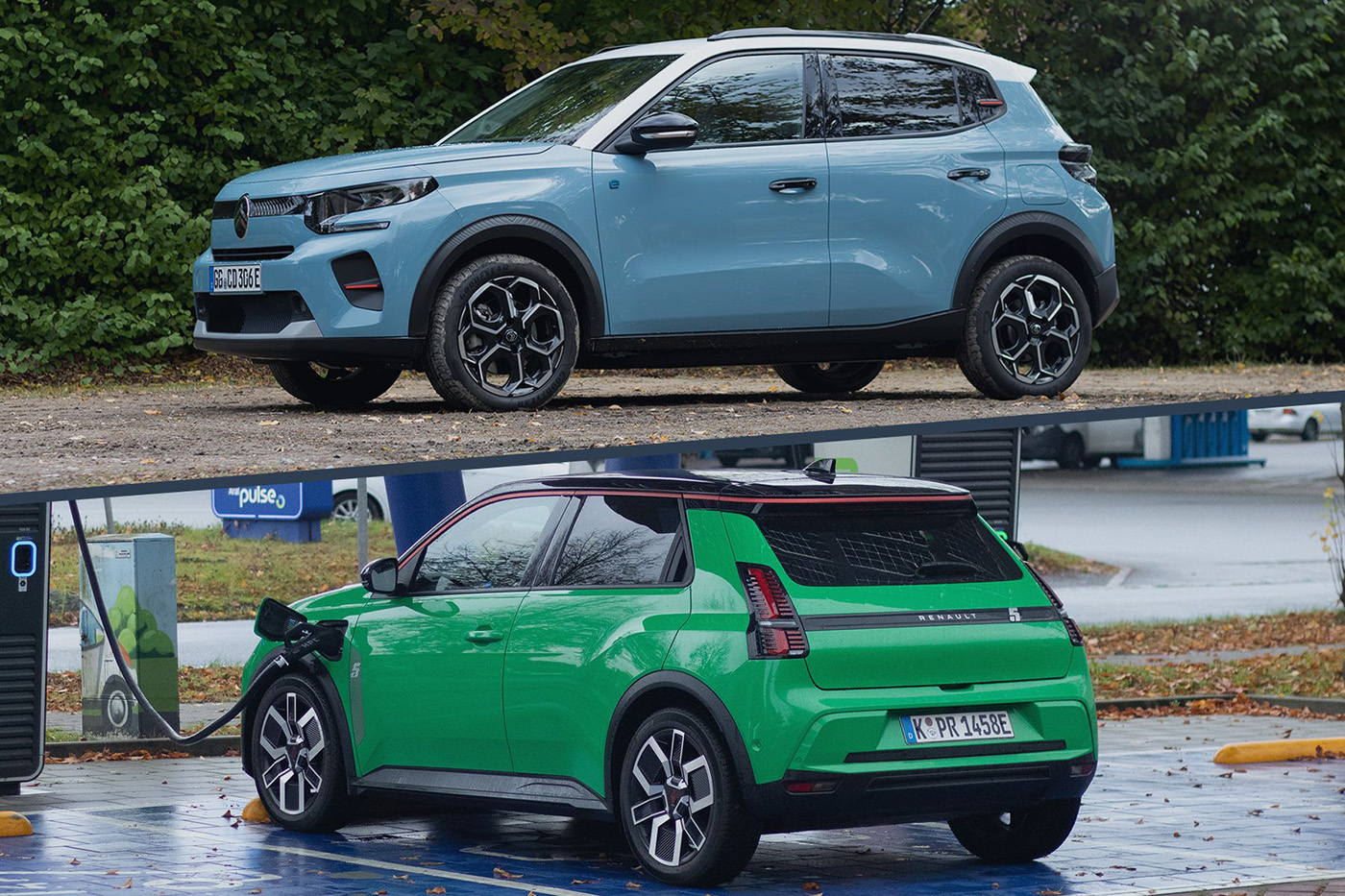
According to Transport & Environment (T&E), the average price of electric cars in the EU fell by around €1,800 (-4 per cent) to €42,700 in 2025. This decline is primarily due to the introduction of affordable battery-electric compact cars in the B-segment, where the average price dropped by 13 per cent. The thinktank highlights the Citroën ë-C3 and the Renault 5 as examples, which were brought to market by manufacturers in time to meet the original CO₂ fleet targets for 2025 (link in German). However, these targets have since been weakened by the EU to a three-year average between 2025 and 2027.
Sebastian Bock, Managing Director of T&E Germany, states: “Fleet emission standards are benefiting the climate and making a difference to consumers’ wallets. Thanks to CO₂ targets, Europe finally has more affordable electric cars. If we stay the course and do not dilute the 2030 targets, new electric cars will soon be cheaper than internal combustion engine vehicles. This will help many Germans escape the fossil fuel trap they are once again feeling at the pump.”
Premium models led the way until 2024
The decline in the average price in 2025 contrasts with the period from 2020 to 2024, during which the average price of electric cars rose by €5,000, according to T&E. This increase occurred because manufacturers primarily focused on larger, higher-margin models such as the Audi Q4 e-tron and Audi e-tron GT, the VW ID.4, ID.5 and ID.7, the BMW iX, i4 and i7, the Mercedes EQE and EQS, and the Porsche Taycan. This strategy was possible because significantly weaker CO₂ fleet targets applied during this period, which did not require a large-scale rollout of affordable electric cars.
At least for now, the focus on higher segments appears to be a thing of the past. This year, manufacturers have already announced further affordable electric cars that are expected to further reduce average prices and CO₂ fleet values. For example, the Volkswagen Group’s small car family, including the VW ID. Polo and Cupra Raval, as well as the compact SUV derivatives VW ID. Cross and Skoda Epiq. Volkswagen is targeting a starting price of around €25,000 for the ID. Polo, while the other models are expected to be slightly above this.
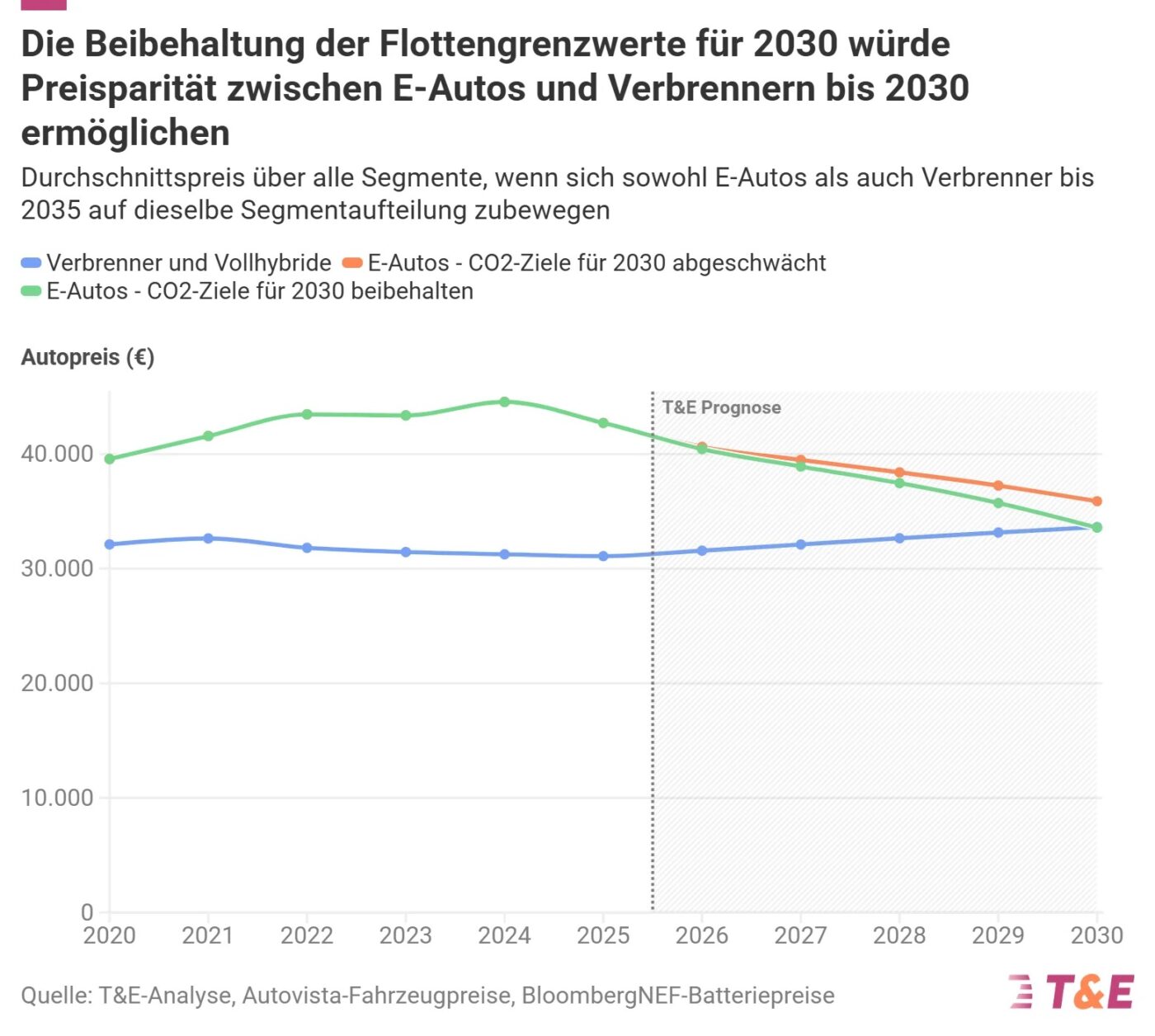
In 2024, battery-electric cars in the D and E segments already achieved price parity with internal combustion engine vehicles, according to T&E. Electric cars in the A, B, and C segments are expected to reach price parity with internal combustion engine vehicles by 2030, provided cost reductions are passed on to consumers, T&E anticipates.
However, this could be delayed if the EU weakens the CO₂ fleet targets for 2030, as proposed by the European Commission. The think tank estimates that an average electric car could be €2,300 more expensive in 2030 than it would be under the current target. The reasoning is clear: if CO₂ fleet targets are weakened, manufacturers are more likely to focus on larger, higher-margin electric cars, which are unlikely to achieve the same sales volumes as smaller battery-electric vehicles.
Weakened CO₂ targets could lead to higher prices
T&E therefore warns that the EU Commission must not further weaken the CO₂ fleet targets. Averaging the 2030 CO₂ target over three years would, according to T&E’s forecast, reduce the market share of electric cars in new registrations in the EU from 57 per cent to 47 per cent by 2030. The automotive industry’s demand to average the target over five years would result in a market share of just 32 per cent in 2030.
Sebastian Bock, T&E expert, adds: “We must not delude ourselves into thinking we can sustainably protect our domestic industry by lowering standards. If the CO₂ targets for 2030 are relaxed, it will only delay the impending price drop for electric cars and secure short-term margins and dividends at the expense of long-term viability. Meanwhile, international competitors are not standing still: Chinese manufacturers are already making significant inroads into the European market and are even overtaking our traditional premium brands in plug-in hybrids. Germany’s response must be technological excellence and a commitment to global leadership, not the dilution of targets.”


0 Comments