


Scandlines puts electric freight ferry ‘Baltic Whale’ into service
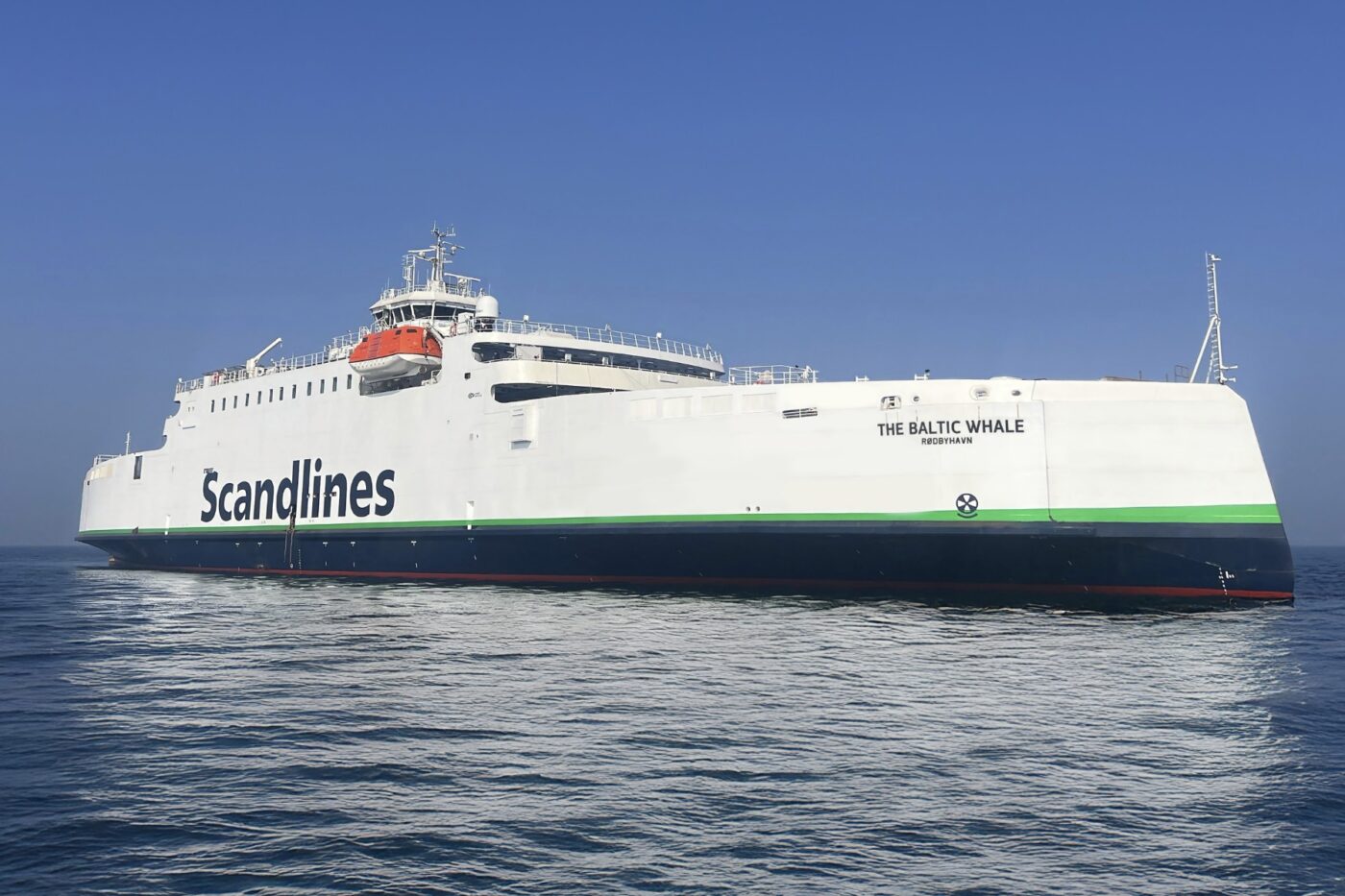
When we first reported on the vessel now named ‘Baltic Whale’ in 2022, it was still referred to as a hybrid freight ferry with the designation PR24, which was expected to enter service as early as 2024. However, the timeline shifted significantly, and on 10 March 2026, the Baltic Whale completed its maiden voyage on the route between Rødby on the island of Lolland in Denmark and Puttgarden on the German island of Fehmarn.
Why has it been referred to as both a hybrid ferry and an electric ferry? Quite simply: both descriptions are correct. The Baltic Whale can operate either fully electrically or as a hybrid system with additional diesel generators. Scandlines has not specified when the vessel will run in fully electric mode and when it will use hybrid mode. However, the company notes that the fully electric journey time for the 18.5 km route between Rødby and Puttgarden is one hour, while hybrid mode reduces this to just 45 minutes.
The ferry has been under construction since 2022 at the Turkish shipyard Cemre, with its 10 MWh battery system supplied by the Swiss battery manufacturer Leclanché. To achieve the rapid charging time of just 12 minutes for this system – roughly equivalent in size to the battery systems of 100 luxury electric cars – Scandlines has invested in a 30 kV / 15 MW cable route with a medium-voltage switchgear and charging station at the port of Puttgarden. In Rødbyhavn, Scandlines has even invested in a 50 kV / 25 MW power cable. The charging tower, transformer, and control and switching systems are installed directly at the berth in the port of Rødby. The charging tower can automatically dock with the ferry in just 15 seconds.
The Baltic Whale was specifically designed for freight transport and offers space for 66 freight units across two decks. It is capable of efficiently and systematically transporting hazardous goods such as industrial products, batteries, cosmetics, and automotive parts. This allows more freight to be carried on this ferry, freeing up capacity for cars and passengers on Scandlines’ other ferries – particularly during peak season.
“The deployment of the Baltic Whale on the Fehmarn Belt is a milestone for Scandlines—a day we have been waiting for over many years. The idea for a battery-powered ferry was first conceived in 2018, and now it has become a reality. It is a great success and something we have been eagerly anticipating,” says Michael Guldmann Petersen, COO of Scandlines.
Scandlines views the new electric ferry as a significant step towards the company’s long-term goal of operating emission-free by 2040 while increasing capacity for freight customers. Since 2013, the company has invested over €430 million euros in emission-reducing technologies, including the Baltic Whale, hybrid ferries, battery systems, rotor sails, energy-efficient propellers, and the electrification of ports.
scandlines.com, shippax.com, mynewsdesk.com (Danish)
1 Comment