


HV-MELA-BAT showcases megawatt charging system
The HV-MELA-BAT project (High-Voltage Megawatt Charging System for Heavy-Duty and Passenger Transport), launched in 2023, aimed to advance fast-charging infrastructure based on the Combined Charging System (CCS) and the Megawatt Charging System (MCS), which was still under development at the time. The consortium included Fraunhofer ISE, Motion Control & Power Electronics, STS Spezial-Transformatoren Stockach, Mercedes-Benz Energy and Fraunhofer IVI.
Following its completion in July 2025, the project has now presented its final results, reporting performance levels that exceed those of many megawatt charging systems currently available. The project partners developed dedicated power electronic inverters and a contact system designed for high currents and voltages.
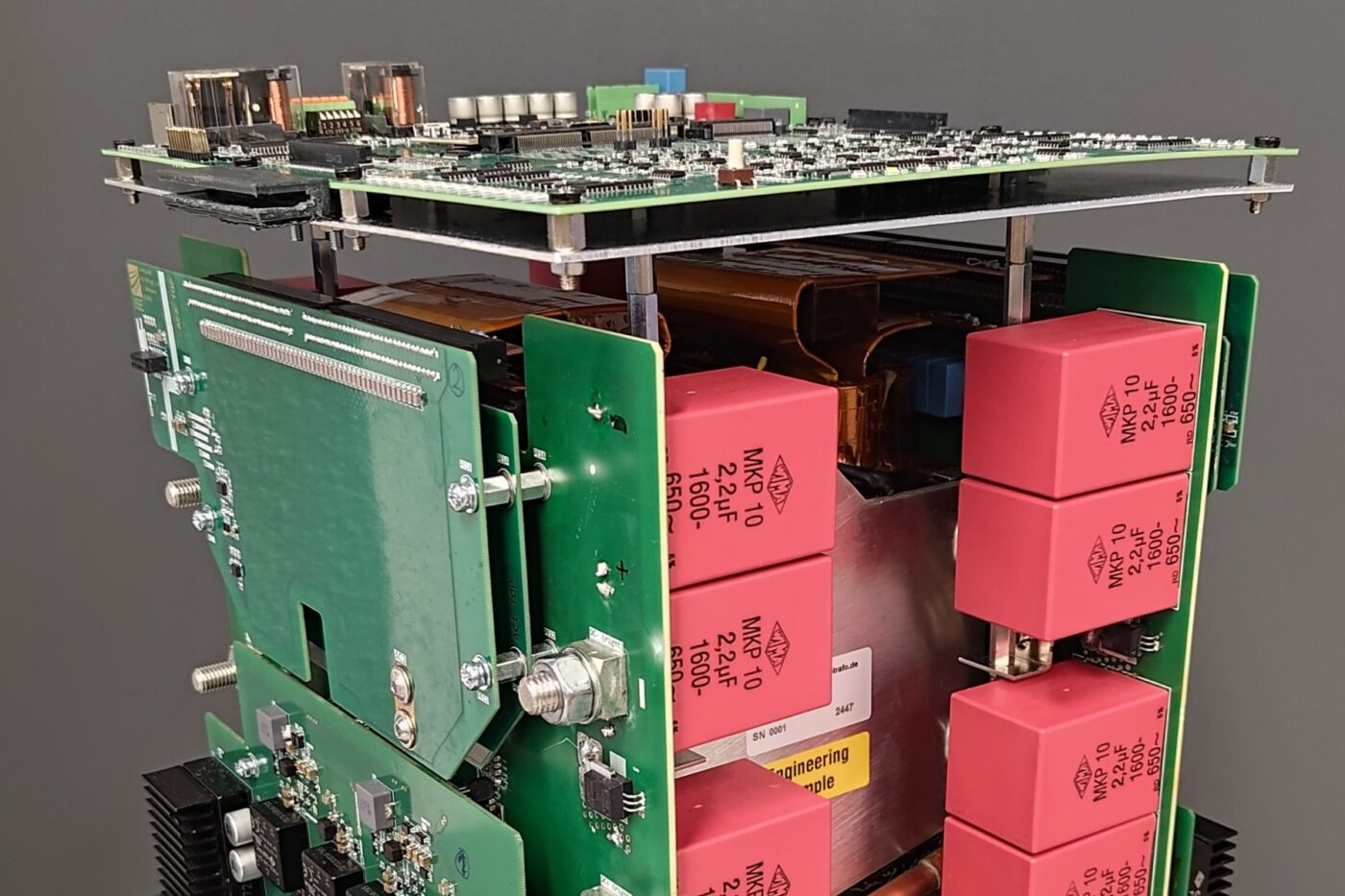
According to Fraunhofer ISE, the isolating DC/DC converter achieves a volumetric power density of 9 kW/l at an efficiency of 99.26 per cent, enabled by a high switching frequency. The institute described this efficiency level as ‘record-breaking.’
The research institution also highlights the newly developed ultra-compact, galvanically isolating DC/DC converter with a transmission power of 250 kW. To achieve a charging power of 1 MW, four of these modular converters are connected in parallel.
The power inverter is based on the topology of a series resonant converter and operates at switching frequencies of up to 200 kHz. This enables smaller inductive components, including the high-frequency transformer and resonant circuit, reducing material use and the overall size of the converter.
To maintain full charging power even where grid connection capacity is limited, the system integrates a buffer storage unit based on second-life Mercedes-Benz passenger car batteries. This stationary energy storage system reduces the required grid connection power of the charging station to 500 kW, while also buffering peak loads and reducing strain on the grid.
0 Comments