


TST launches ‘dragonize’ depot charging network to scale electric truck operations
The initiative builds on earlier plans presented in 2025 at the Transport Logistic trade fair in Munich. According to the company, both the brand and the underlying technical platform have now been released for market deployment.
TST describes dragonize as a cooperative system designed to connect logistics players and enable shared access to depot-based charging infrastructure. “With dragonize, a network is emerging that connects the industry and enables the next step towards efficient, electrified logistics,” the company said.
Cooperative approach to depot charging
The dragonize concept follows cooperative principles: participating freight forwarders can use external infrastructure and contribute their own charging points to the network. The aim is to create a shared ecosystem that integrates infrastructure, operations and digital services.
TST states: “From the exchange of individual freight forwarders and logistics providers, a tailored logistics ecosystem and charging network is created. From many individual charging parks, a shared network emerges.”
The platform includes a digital layer called DepotOS, designed to centralise charging planning, reservation, routing and operations. Additional services include infrastructure planning and construction, maintenance and full transparency across partners and data.
The company adds: “Instead of many interfaces, an integrated system is created. Instead of uncertainty, planning reliability emerges.”
Katrin Herda, Managing Director of PamSun GmbH, a TST subsidiary and the brand behind the charging network, emphasised the practical origin of the project: “dragonize was created from practice – together with the industry. Not as a concept, but as a solution for real operations. Real logistics power is created through collaboration.”
“dragonize is more than charging infrastructure. It is a system that reduces complexity and gives the industry back its independence,” the company added.
Worms charging hub as starting point
The network builds on TST’s own charging infrastructure under the PamSun brand, launched in 2023. The first major project was inaugurated in March 2025 at the company’s headquarters in Worms.
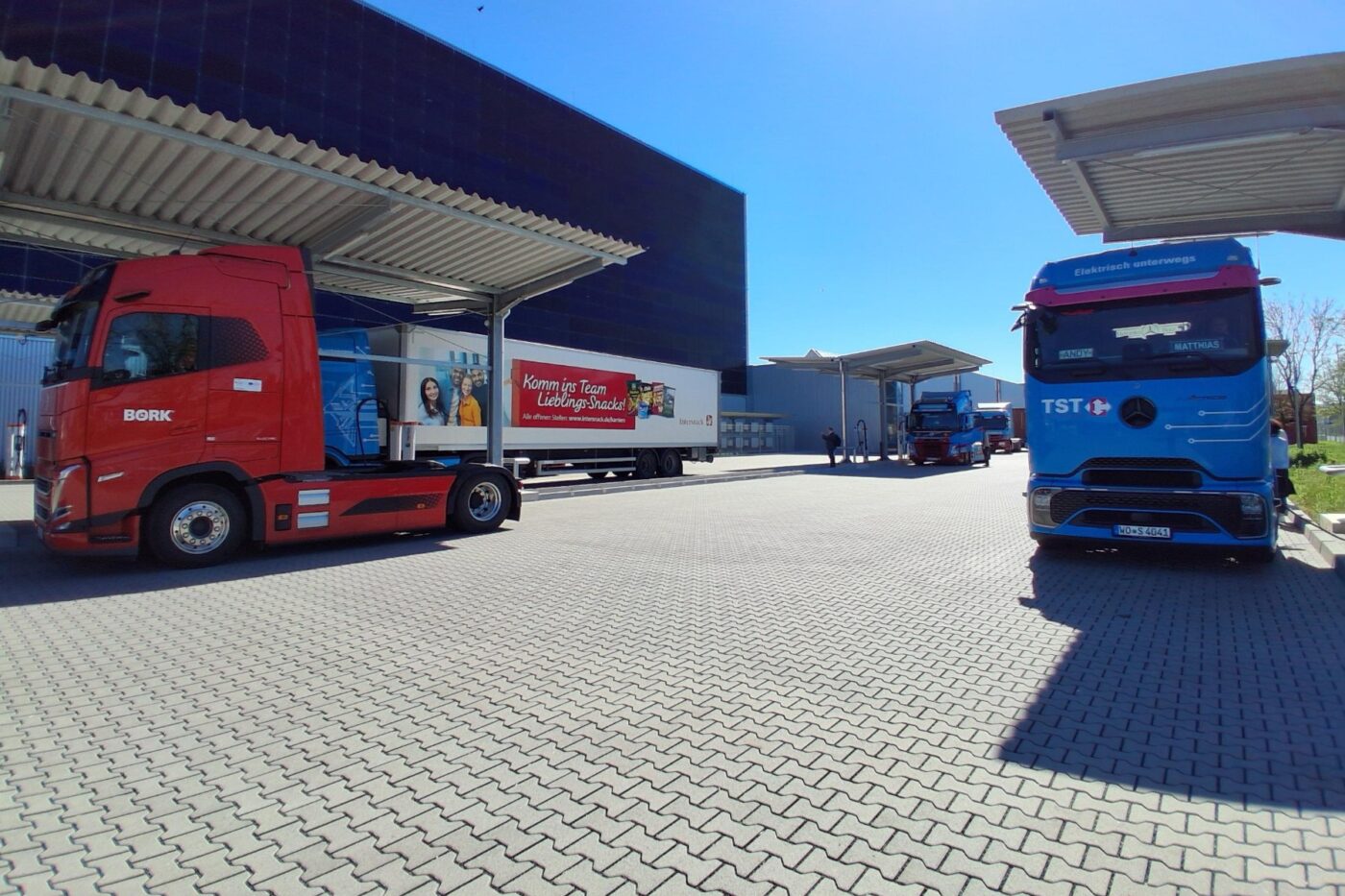
The site features eight charging points with capacities of 3 × 400 kW, 3 × 240 kW and 2 × 160 kW. It is accessible to third parties and designed specifically for heavy-duty vehicles. “45-tonne trucks can drive in without uncoupling,” Herda said.
The Worms site currently supports both TST’s own electric fleet and external users. The facility in Worms is supplied partly by on-site photovoltaic systems with a total capacity of 7.5 MW installed across surrounding buildings.
Sebastian Crusius, Interim Chief Operating Officer and Chief Sales Officer of dragonize, stated that more than 20 logistics companies are already using the charging park at the company’s site in Worms. Moreover, the company reports initial interest from logistics operators beyond Germany, indicating potential for cross-border expansion of the network. Though it did not go into detail or name any names at this point.
Nevertheless, the image provided by dragonize shows a truck by the German logistics company Bork. The latter is one of Daimler Truck’s logistics partners that uses a battery-electric Mercedes-Benz eActros 600 for deliveries to Daimler Truck factories. It is thus possible that the freight forwarder is indeed also part of the dragonize network.
dragonize told electrive that additional charging parks are planned in the German federal state of Hesse. Incidentally, Bork’s headquarters are in Langgöns, a city located in Hesse. Earlier plans included TST locations in Wevelinghoven and Alzey, with additional sites under development. The company is also considering different infrastructure formats, including fast-charging hubs for driver breaks, larger charging parks with overnight facilities, and charging solutions integrated directly into loading bays.
TST Logistik is not the first player to move into semi-public truck charging. A growing number of large and small companies see depot connectivity as a key lever for scaling electric truck adoption.
In Germany, for example, transport insurer KRAVAG (link in German), part of the R+V Group, has developed an app that enables freight forwarders to offer, find and bill for truck charging points. Meanwhile, Daimler Truck recently announced TruckCharge, a semi-public truck charging network in Europe by enabling dealers and customers to open their depot chargers to third parties as standard. A similar approach emerged in mid-2024, when MAN and E.ON launched a joint initiative focused on opening MAN’s dealer network for truck charging, albeit on a smaller scale.
Tackling cost pressures and operational complexity
The launch of dragonize is driven by challenges faced by logistics operators during the transition to electric mobility, particularly high energy costs and limited infrastructure availability.
Katrin Herda previously highlighted the economic pressure experienced during early operations. “When we started with our electric trucks in July 2024, we had no charging infrastructure. We relied on public networks, where we paid up to 81 cents per kWh. At that level, every business case for an electric truck is dead,” she said in an earlier interview with electrive.
The cooperative model is intended to provide a stable framework for addressing technical, operational and economic issues collectively. The concept was developed in workshops with other logistics companies, where they were able to say what they need to operate (and charge) electric trucks. It also aims to ensure that smaller logistics companies are not excluded from the transition.
“As the industry gets ready for electric trucks, we’re taking the next step: electric truck proof,” said Herda. “That means reliable hardware, integrated systems and smooth on-site operations. The result is a charging infrastructure that works reliably, predictably and cost-effectively in day-to-day logistics operations.”
The company is also working on integrating stationary battery storage systems of up to 6–7 MWh into local charging ecosystems to optimise energy use. In parallel, it is developing new technical solutions for charging at loading ramps, although regulatory requirements such as metering compliance remain a challenge.
0 Comments