

RWTH offers ready-to-use technical kit for fuel cell range-extended electric trucks
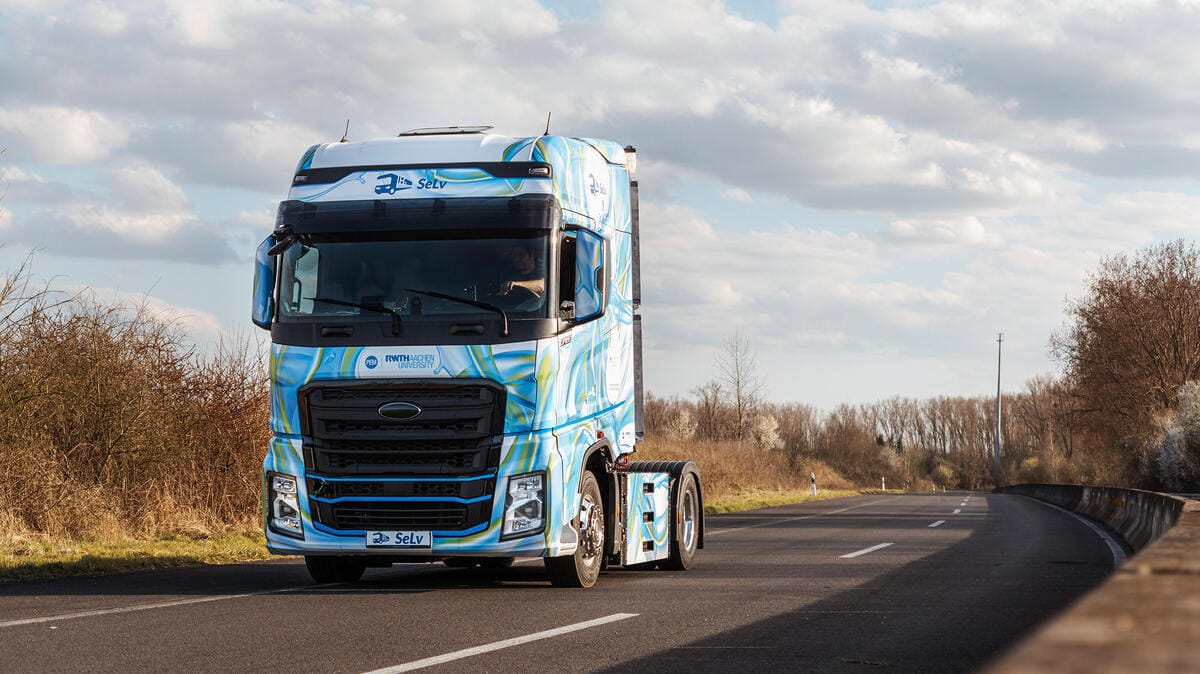
In the SeLv research project, which is funded by the German government with 16.9 million euros, Germany’s second-largest technical university has been developing a modular powertrain for trucks since 2021. RWTH Aachen University has now announced the completion of the project. The acronym SeLv stands for ‘Schwere Lastkraftwagen für die emissionsfreie Logistik im Schwerlastverkehr mittels Elektrifizierungsbaukasten und wirtschaftlichem Produktionssystem’ (Heavy-Duty Trucks for Zero-Emission Logistics in Heavy-Duty Transport Using an Electrification Kit and Economical Production System). The project primarily focused on developing a battery-electric powertrain with a fuel cell range extender for commercial vehicles with a permissible gross weight of 41 tonnes.
To mark its conclusion, the PEM team presented a third prototype truck alongside a second study vehicle with official road approval. The modular system enables the conversion of existing diesel trucks into electric trucks and is suitable for relevant OEMs and vehicle retrofitters. It is also set to be made available to niche sectors such as construction machinery in the future, according to the project team. “Many suppliers find it very difficult to bring new ideas to market these days,” commented PEM Director Professor Achim Kampker. He added that the automotive industry often replies with questions such as “Is this already up and running?” or “How safe is it anyway?”
According to Kampker, the SeLv truck represents ‘a real platform with road approval,’ which future stakeholders can use to integrate their own battery, hydrogen, and thermal management technologies or software applications. They will also receive support in developing these technologies for series production. The SeLv project has overcome numerous obstacles in recent years: “A major obstacle during development was that many components for electrification in the heavy-duty vehicle class were still in the prototype stage and therefore not available on the market,” emphasised PEM expert and homologation officer Michael Betz.
The results of this painstaking work are impressive: depending on the configuration of the hydrogen tanks located behind the vehicle cab, the project’s electric truck is expected to achieve a range of 750 to over 1,000 kilometres. On board the truck, which has a peak output of nearly 470 kW and a continuous output of around 400 kW, there is also a navigation system that calculates the optimal route based on the available hydrogen refuelling and battery charging infrastructure, including relevant refuelling and charging stops. An intelligent energy management system further ensures that battery and fuel cell power are distributed according to the driving profile to achieve optimal efficiency.
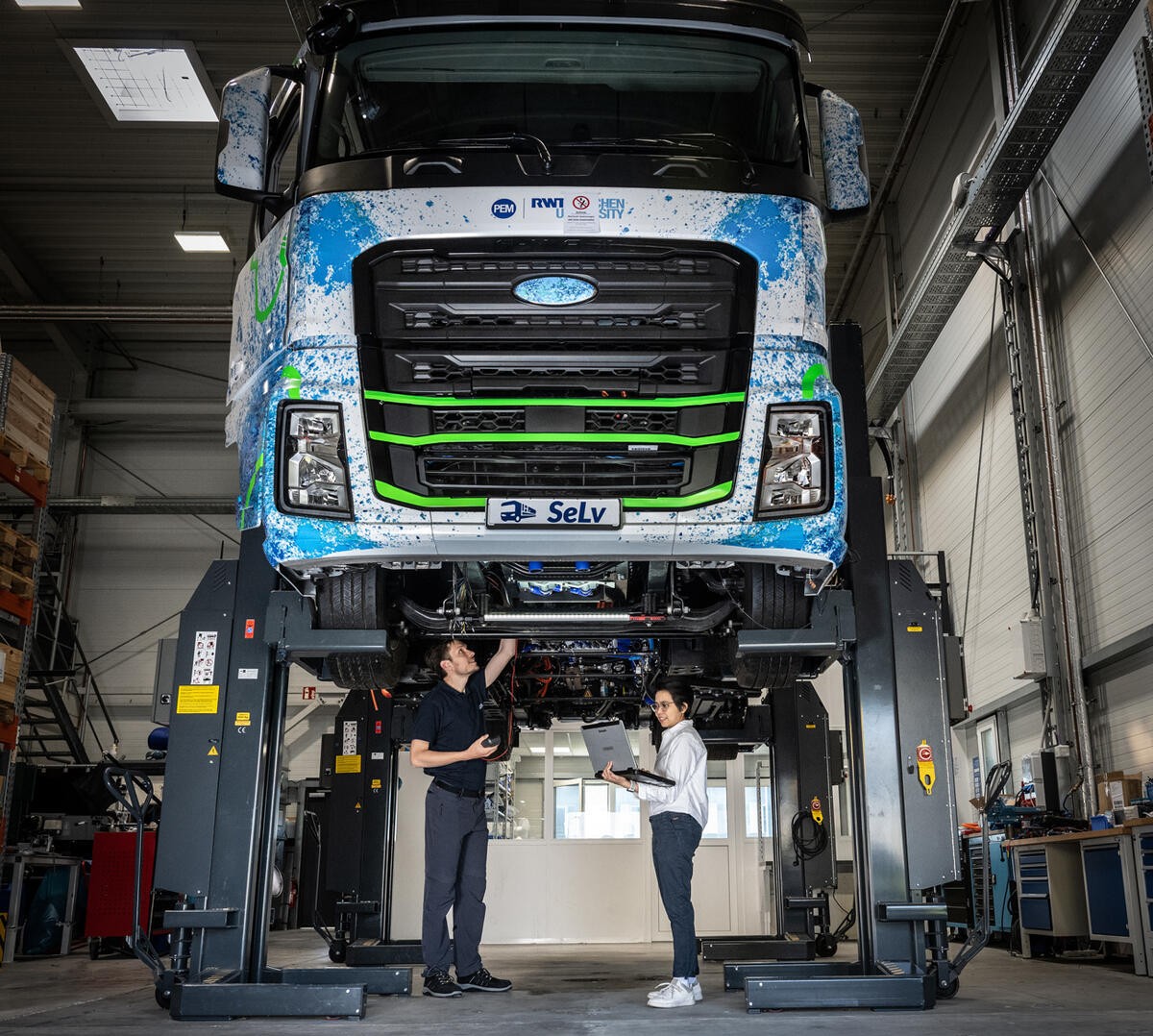
According to the team, the SeLv project has implemented several innovative ideas aimed at ‘significantly reduce development and system complexity within the highly regulated and relatively sluggish automotive industry.’ “A young research team and experienced development specialists have combined industrial standards with new scientific approaches in a unique way,” said PEM project manager Michael Demming.
One of the project’s major achievements, according to Demming, is the modular kit concept, which allows for extensive pre-assembly of the powertrain outside the vehicle. The latest technical data for prototypes two and three (‘SeLv 2’ and ‘SeLv 3’) include, alongside the aforementioned output and ranges, a net battery capacity of 368 kWh (LFP chemistry) and a charging power of 250 kW. The PEM team states the fuel cell output as 170 kW. The differences in range result from the hydrogen tank capacity, which amounts to 35 kg at 350 bar or 70 kg at 700 bar.
Incidentally, in October 2022, the RWTH chair had already presented the prototype in motion for the first time—albeit purely battery-electric at the time. The newly road-approved successor was also on display at the NUFAM trade fair in Karlsruhe last autumn, as reported here.
The vehicle features a modular powertrain designed to enable custom configurations. According to PEM, the focus of the development lies on the industrialisation of production processes for the powertrain, with the goal of achieving volume-based cost advantages in manufacturing. The developers have not yet disclosed further technical details about the vehicle.
0 Comments