

Double-digit revenue decline: Tesla’s automotive business contracts
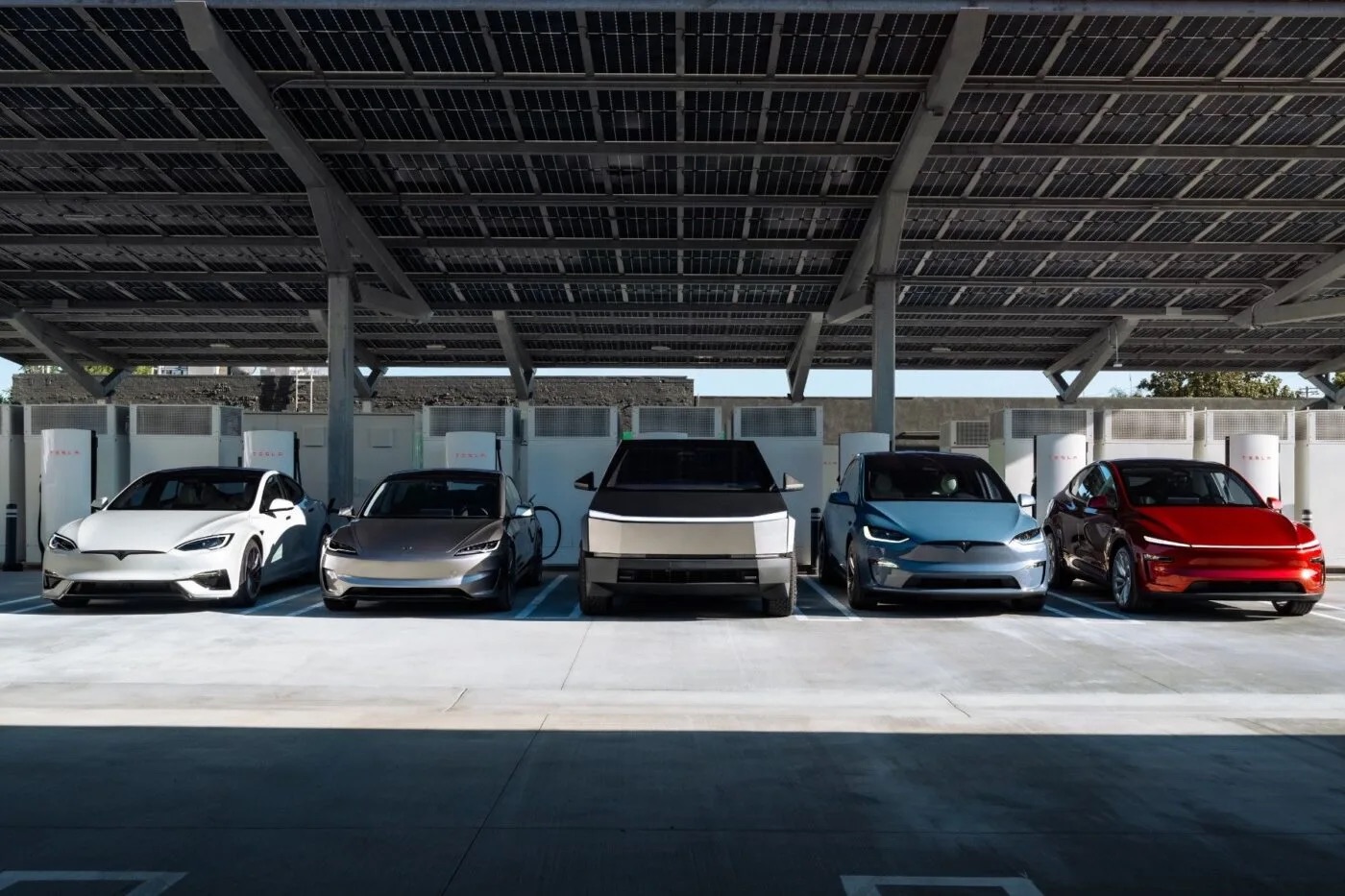
Twelve months ago, Tesla had declared 2025 to be a ‘seminal year in Tesla’s history.’ And yes, the first electric robotaxis have since entered service in the US in isolated cases. But the outlook darkened significantly for Tesla’s volume business. CEO Elon Musk did the electric carmaker no favours with his controversial political activities. At the end of September, the US scrapped the 7,500-dollar tax credit for the purchase of electric cars, weakening the US market across the board. And the once much-hyped Cybertruck also failed to gain traction in 2025, while over the full year, Tesla had little to offer in terms of new products beyond the Juniper facelift of the Model Y.
This combination of self-inflicted challenges and external factors has left clear marks on Tesla’s business report for the fourth quarter and the full year 2025. After textbook annual profits of 12.6 and 15.0 billion dollars in 2022 and 2023, the company suffered a sharp earnings slump in 2024 (7.1 billion dollars, -53%). It now has to accept an even weaker result: all told, Tesla ended 2025 with a meagre annual surplus of just 3.79 billion dollars. That is roughly what Tesla sometimes earned in a single quarter during its peak years of 2021 and 2022 (for example, in Q4/2022, with 3.69 billion dollars). Above all, Tesla has to face the fact that its profit almost halved again within a single year (-46% YoY).
What is also striking: even revenue, long considered a reliable constant at Tesla, declined for the first time ever in 2025. The 94.83 billion dollars came in below the 2024 figure (-3% YoY) and also slightly below the 2023 result. The contraction is even more evident in the key automotive segment: for 2025, Tesla booked revenue of just 69.53 billion dollars here, ten per cent less than in 2024 – and the lowest level in three years. The comparison shows that Tesla avoided a double-digit drop in total revenue only thanks to its diversification. The energy division (stationary storage batteries and solar roofs) generated 12.77 billion dollars in revenue in the past year (+27 per cent), while services/other reached 12.53 billion dollars (+19 per cent). At present, Tesla is growing only in these areas.
Q4 profit slips below the billion-dollar mark
A look at the fourth quarter shows that the manufacturer achieved rather moderate global deliveries of 418,227 vehicles (-15.6% YoY). Revenue from the automotive business fell by a similar eleven per cent between October and December to 17.69 billion dollars. This figure is clearly down in the third quarter (21.21 billion USD). This comes as little surprise: in the US, many buyers likely brought forward their Tesla purchases before the tax credit expired at the end of the fourth quarter. As the subsequent shortfall in sales affected only the electric car business, while the energy and services divisions continued to grow, Tesla’s total Q4 revenue declined by ‘only’ three per cent to 24.9 billion dollars. This is a modest figure for the company, but not a disastrous one.
Where the pain is far greater is in Q4 profit. Here, the result drops back into nine-digit territory: Tesla has to make do with 840 million dollars, a fall of 61 per cent year on year and, with the exception of the crisis quarter Q1/2025, the lowest quarterly surplus since mid-2021. If there is a positive aspect to highlight, it is the operating margin, which has at least stabilised at just under six per cent. Even so, the conclusion remains clear: quarterly surpluses of more than 2 or 3 billion dollars – as seen during the boom quarters of 2021 and 2022 – or double-digit margins are currently a distant prospect for the US electric carmaker.
That 2025 was not an easy year for Tesla had already become apparent earlier in the month when looking at deliveries. The company had long since abandoned its medium-term target of increasing car sales by 50 per cent every year. In 2025, Tesla recorded a decline in deliveries for the second year in a row. While the drop in 2024 was still modest, it became much more pronounced in 2025: deliveries fell by 9.1 per cent to around 1.6 million vehicles. BYD – still Tesla’s main rival in the global BEV race in 2024 – pulled far ahead in 2025. This illustrates just how sharply competition is intensifying with new models in China and Europe. And the US? There, the Trump administration is doing everything it can to keep electric mobility in general in check.
‘Correct strategy to win the autos market of the future’
A difficult mix for Tesla, although management shows little self-criticism in the business report and considers itself on the right track: “In 2025, we completed the refresh of our vehicle lineup with the launch of the new Model Y, including additional variants. We believe that maintaining an optimised and efficient product portfolio, with a continued focus on high-value features such as long range, best-in-class software and autonomy, is the correct strategy to win the autos market of the future.”
Tesla briefly addresses the decline in car sales, but prefers to emphasise the improved gross margin and strong business in the APAC region. Europe, where performance was known to be weak, does not get a single mention in this context. Nor does China. Instead, the carmaker shifts attention to upcoming milestones, such as the ramp-up of the Semi electric truck and the Cybercab planned for the first half of 2026. Tesla also revives the NextGen Roadster, stating that it is preparing its production.
Software, robots and AI take up more space
What is striking is what Tesla no longer mentions in the business report: most notably, there is no longer any update on progress at the individual vehicle plants. Instead, the manufacturer gives more room in the report to its other business and development fields: AI, FSD software, robotaxis, the Optimus robot, energy storage systems. It becomes clear that Tesla a) avoids dwelling on the weak figures in its automotive business and b) is in fact continuing to diversify further.
Accordingly broad is the ‘Outlook’ section at the end of the business report: according to Tesla, it plans to bring six new production lines online in 2026 across vehicle, robot, energy storage and battery manufacturing, all ‘while further leveraging our existing factory, charging and service centre footprint to support future growth.’ Concrete forecasts for vehicle sales, however, have been absent from Tesla’s communications for some time now.
Management merely states that it intends to focus on maximising utilisation of its existing plants. It then adds the noteworthy sentence that future deliveries will not only be determined by demand and the supply chain, but also by ‘allocation decisions between sale to customers or use for our owned and operated fleet.’ The company does not go into further detail at this point.
It is quite possible that Tesla is referring to its robotaxi fleet, which is expected to grow rapidly this year. After Austin and the San Francisco Bay Area (where vehicles are still operating with a safety driver on board), Tesla plans to establish further operations in Dallas, Houston, Phoenix, Miami, Orlando, Tampa and Las Vegas within the first half of the year.
0 Comments