


UK EV market grows but share declines
According to the Society of Motor Manufacturers and Traders (SMMT), the February figures mark the second consecutive month in which the BEV share fell year-on-year. In January, the number of newly registered battery-electric cars grew slightly, but their market share fell to its lowest level since April 2025. According to SMMT, the development partly reflects a strong start to 2025, when buyers accelerated electric vehicle purchases ahead of the introduction of new tax rates in April.
Additional deliveries at the end of last year, aimed at meeting the UK’s Zero Emission Vehicle (ZEV) mandate targets, also contributed to the comparison effect.
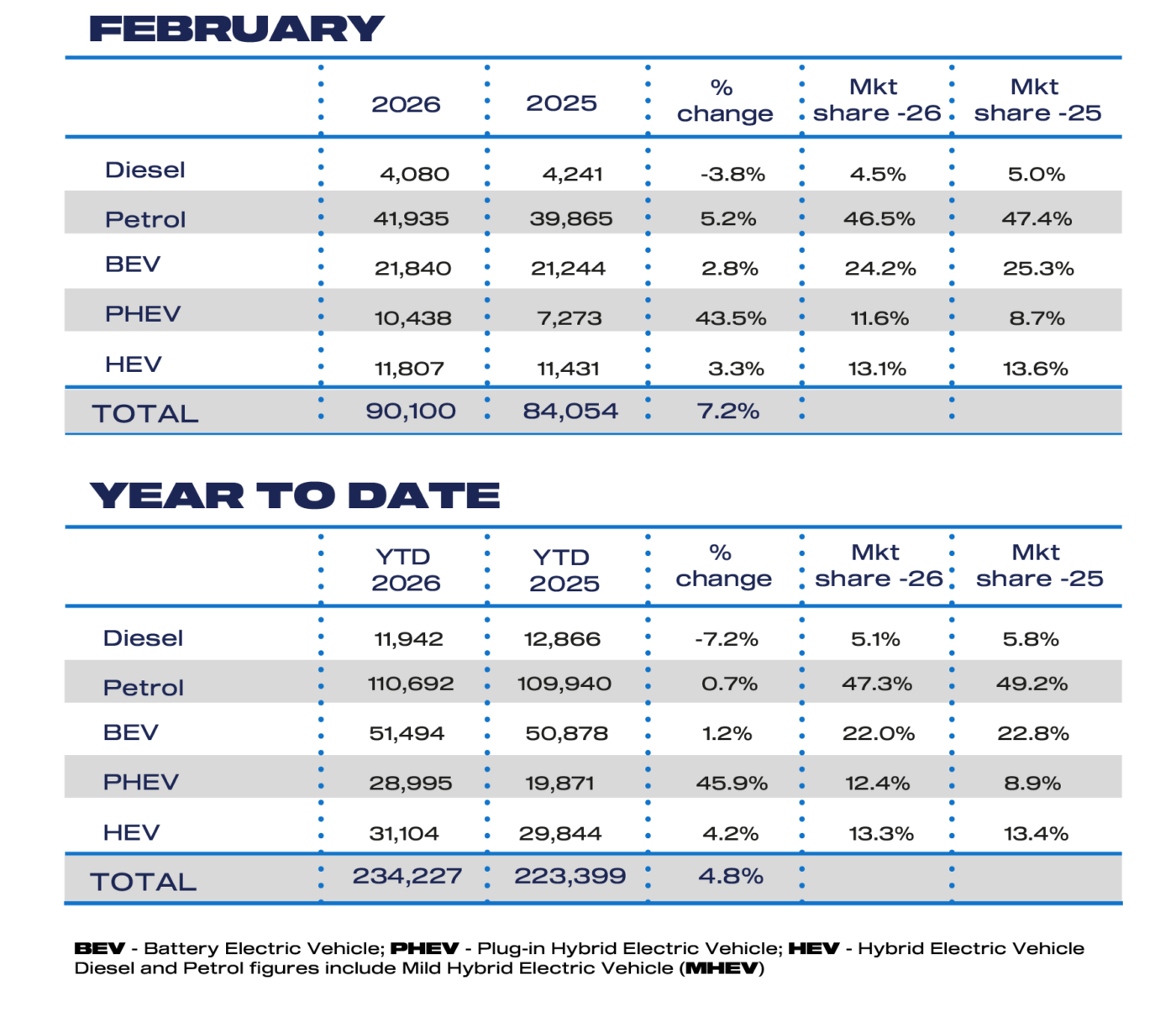
Overall, the UK new car market grew by 7.2% in February, supported mainly by a recovery in private retail demand. As mentioned above, BEVs accounted for 24.2% of the 90,100 new cars registered during the month, although their market share declined compared with the same period last year.
However, electrified powertrains continue to account for a growing share of the market. Alongside BEVs, plug-in hybrid vehicles recorded the strongest growth in February, with registrations rising by 43.5% to represent 11.6% of the market. Hybrid electric vehicles also increased, up 3.3% with a market share of 13.1%.
Despite the growth in BEV volumes, the pace of adoption remains below the level required under current regulation. Year-to-date, battery-electric vehicles account for 22.0% of new car registrations in the UK. Under the ZEV mandate, however, the share of zero-emission cars sold by manufacturers must reach 33% in 2026.
March is expected to be a key month for EV uptake, as the new numberplate typically drives higher sales volumes.
“The UK’s new car market is continuing to recover and EV volumes are growing too, even if market share remains disappointing. All eyes are now on ‘new plate’ March, which typically sets the tone for the year – and given sales of new pure petrol and diesel cars are currently required to end in less than four years, EV uptake must accelerate rapidly,” said Mike Hawes, Chief Executive of the SMMT.
Hawes added: “Manufacturers have committed monumental investment to drive demand but such costs cannot be sustained indefinitely, making a review of the transition an urgent priority to ensure ambition matches natural demand.”
Update 6 March 2026
In February, 2,009 battery-electric light commercial vehicles were registered in the UK, representing an increase of 42.2% compared with February 2025. The surge pushed the market share of battery-electric vans to 13.5 per cent of all new light commercial vehicle registrations in February. Despite the strong growth, the share remains well below the 24 per cent required under the UK’s zero-emission vehicle mandate for 2026.
Over the first two months of the year, battery-electric van registrations reached 3,853 units, marking a year-on-year increase of 33.9 per cent. This gives electric vans a market share of 11.8 per cent for the period, still less than half of the mandated target.
Industry representatives note that a wide range of electric van models is now available on the market, yet uptake continues to lag behind regulatory requirements. According to the SMMT, more than half of all van models are already offered with battery-electric powertrains, often accompanied by significant purchase incentives.
Mike Hawes, Chief Executive of the SMMT, said: “The van market’s modest growth in February is welcome, as is another month of rising demand for electric models. Pickup registrations, however, continue to lag given last year’s fiscal changes, while EV uptake remains far below the level required by regulation, despite more than half of all models being available as EVs and with massive discounts on their sale. That is unsustainable and therefore requires a wholesale review of the transition to ensure we have a framework that is realistic, deliverable and affordable.”
smmt.co.uk (cars), smmt.co.uk (LCVs)

1 Comment