


MG Motor plans European rollout of semi-solid-state batteries by year-end
MG’s new Engineering Centre in Frankfurt, Germany, is set to support the company’s ‘In Europe, for Europe’ strategy, as announced by the organisation. This approach reverses the norm. European companies typically emphasise their ‘In China, for China’ strategies, while Chinese manufacturers strive to bring their core technologies—developed in China—to Europe.
Although several Chinese automakers have established development centres in Europe, often in Germany, these usually focus on localisation, chassis development, or collaboration with European suppliers. However, critical components such as batteries and powertrains are typically developed in China.
MG, originally a British brand and now part of the Chinese SAIC Group, already has a European base with engineering teams in Longbridge, UK, and a design centre in London. The new German site ‘will focus on developing vehicles tailored to the specific needs of European customers, including regional climate conditions, road environments and driving lifestyles.’
Around the opening of the Frankfurt development centre, MG also introduced a technology ‘specifically for the European market,’ which addresses ‘regional road conditions, climate variations and regulatory requirements.’ This technology is the ‘SolidCore’ battery, a new battery cell featuring a semi-solid electrolyte.
Semi-solid-state cells touted as ‘significant advancement’
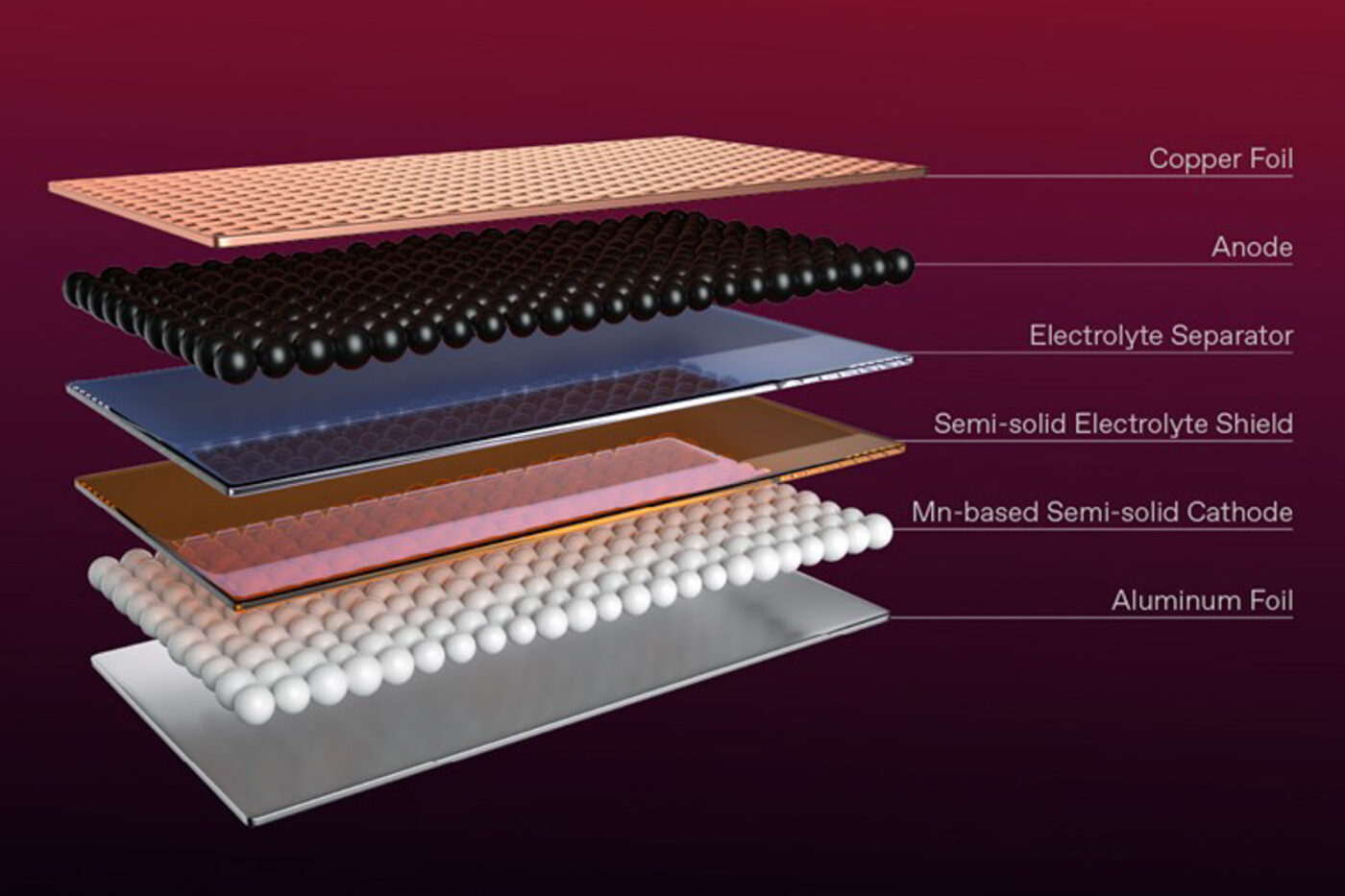
The ‘SolidCore’ battery incorporates solid-state electrolytes, which, according to MG, form a protective structure within the cells. The term ‘incorporates’ means that these solid-state electrolytes are integrated to create this protective structure, while liquid electrolyte components are still used. Thus, it is not an ‘all-solid-state’ battery; MG itself describes it as ‘semi-solid-state’ technology.
According to an infographic, the anode is conventionally structured, with active materials—presumably predominantly graphite—applied to a copper carrier foil. However, the innovation lies behind the separator foil: a manganese-based ‘Semi-Solid Cathode’ is applied to the aluminium cathode carrier foil, which is then protected by the ‘Semi-Solid Electrolyte Shield.’
With this design, MG aims to achieve ‘a significant advancement in electric vehicle battery technology.’ The company claims not only to be the first to mass-produce a semi-solid-state battery but also to offer a particularly safe and durable battery—though these claims are not supported by specific figures.
The same applies to the purportedly greater range and faster charging times. However, MG Motor highlights the battery’s performance in low temperatures. “This architecture performs exceptionally in low-temperature conditions, enabling immediate vehicle start-up without preheating and providing improved acceleration compared with conventional EVs under similar conditions,” the company stated.
It remains unclear how the newly presented semi-solid-state battery, ‘designed specifically for the European market,’ differs from the semi-solid-state battery that the automaker has already been delivering in the new MG4 in China since December.
The cells used there are supplied by the startup QingTao Energy, in which MG’s parent company SAIC has invested for years. The manganese-based solid-state battery contains five per cent less liquid electrolyte than conventional lithium batteries. The battery’s energy content is 53.95 kWh, and with 2C fast charging, it can be charged from 30 to 80 per cent in 21 minutes.
In addition to battery development, MG is also advancing its hybrid technology—for full hybrids. The ‘Hybrid+’ technology includes a 1.83 kWh battery, a novel three-speed hybrid transmission, a fully integrated ‘Hybrid Control Unit’ with ‘real-time terrain detection,’ and intelligent control with up to eight driving modes.
1 Comment