


Nearly 200,000 electric cars registered in May as EU retains momentum

Figures published by the European industry association ACEA highlight that in May, 203,417 new battery-electric cars were registered in the EU – a figure consistent with the April statistics (200,117 units). Only in March did registrations reach a higher level – with 234,532 new battery-electric passenger cars sold. Compared to May 2025, the roughly 200,000 new electric vehicles represent a 42.9 per cent increase. For context, the EU’s overall passenger car market grew by 3.2 per cent in May compared to the previous year.
In the first five months of 2026, a total of 950,521 new battery-electric passenger cars were registered in the EU, corresponding to a 20 per cent market share. This confirms that the one-million mark will be surpassed in June. ACEA also notes that three of the four largest EU markets—accounting for 63 per cent of all BEV registrations—have shown strong growth year-to-date: Italy (+75.7 per cent year-on-year), France (+55.4 per cent), and Germany (+40.9 per cent). In contrast, Belgium recorded only modest growth (+2.8 per cent), while the Netherlands saw a decline (-9.7 per cent).
Looking at other drivetrain types: hybrid vehicles (HEVs) were the most popular in May 2026, capturing 37.8 per cent of the market. Petrol-powered cars accounted for 22.4 per cent, closely followed by battery-electric cars at 20 per cent. Plug-in hybrids (PHEVs) held a 9.7 per cent share, ahead of diesel vehicles (7.6 per cent). The trend is clear: internal combustion engines continue to lose ground, with their combined market share falling from 38 per cent to 30.1 per cent over the past year.
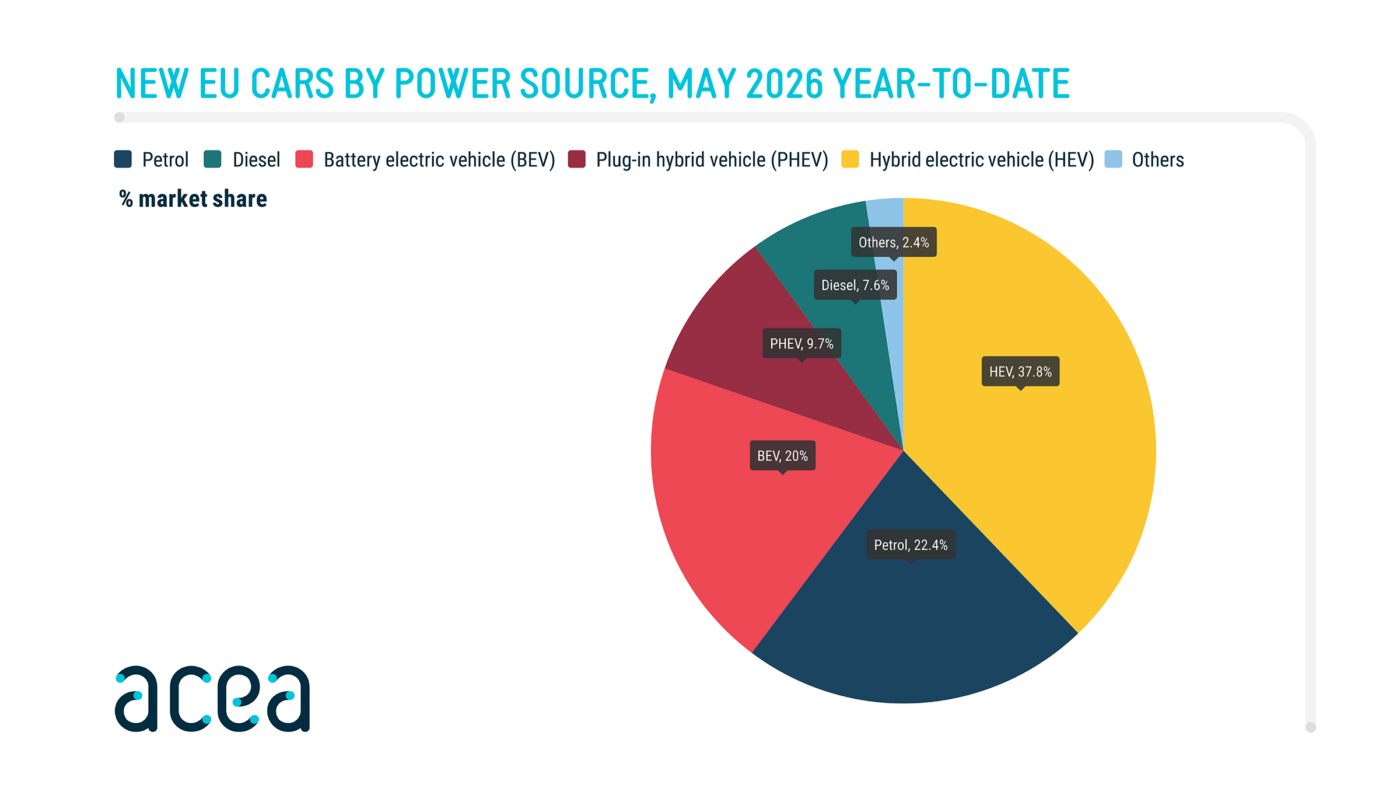
An important detail: ACEA does not differentiate between levels of electrification within the HEV category. The high market share thus includes both full hybrids and mild hybrids. This means vehicles that, for example, use a small electric motor solely as a starting aid or for turbocharging – but cannot drive even a metre on electric power alone – are also counted as hybrids. For customers, these vehicles feel like conventional combustion engine cars, even though they are officially classified as hybrids. The decline in combustion engine vehicles is therefore partly shifted to hybrids without significant climate benefits. Germany remained the largest single market for electric cars in May. Here, 59,969 BEVs were newly registered, a 39.3 per cent increase compared to the same month last year. France recorded 37,412 electric car registrations, marking an impressive 93 per cent rise. Denmark followed with 15,020 new BEV registrations, a 37.3 per cent increase. In the EU rankings, Italy came next with 13,274 BEV registrations (+86.5 per cent year-on-year), followed by Belgium with 12,586 electric cars (+11 per cent year-on-year) and Spain with 12,049 electric vehicles (+34.5 per cent year-on-year). The Netherlands is slowly regaining its former strength, with 12,363 units registered (+4.9 per cent year-on-year).
ACEA’s manufacturer statistics, however, still do not break down by drivetrain type. This means that only Tesla, as a pure BEV manufacturer, can be analysed in detail, as all other listed carmakers also offer hybrids and/or plug-in hybrids. Tesla’s figures are particularly striking: the brand achieved 21,767 new registrations in Europe (EU, EFTA, and the UK) in May, a 152 per cent increase compared to the previous year. With 268,487 electric vehicles sold in this economic region, Tesla accounted for roughly 8 per cent of the total. The company’s performance is clearly recovering, as shown by the year-to-date figures: from January to May, Tesla sold 89,180 vehicles, a 77 per cent increase, averaging around 18,000 vehicles per month.
acea.auto (PDF)

0 Comments