


Changan Qiyuan A06 receives sodium-ion batteries from CATL
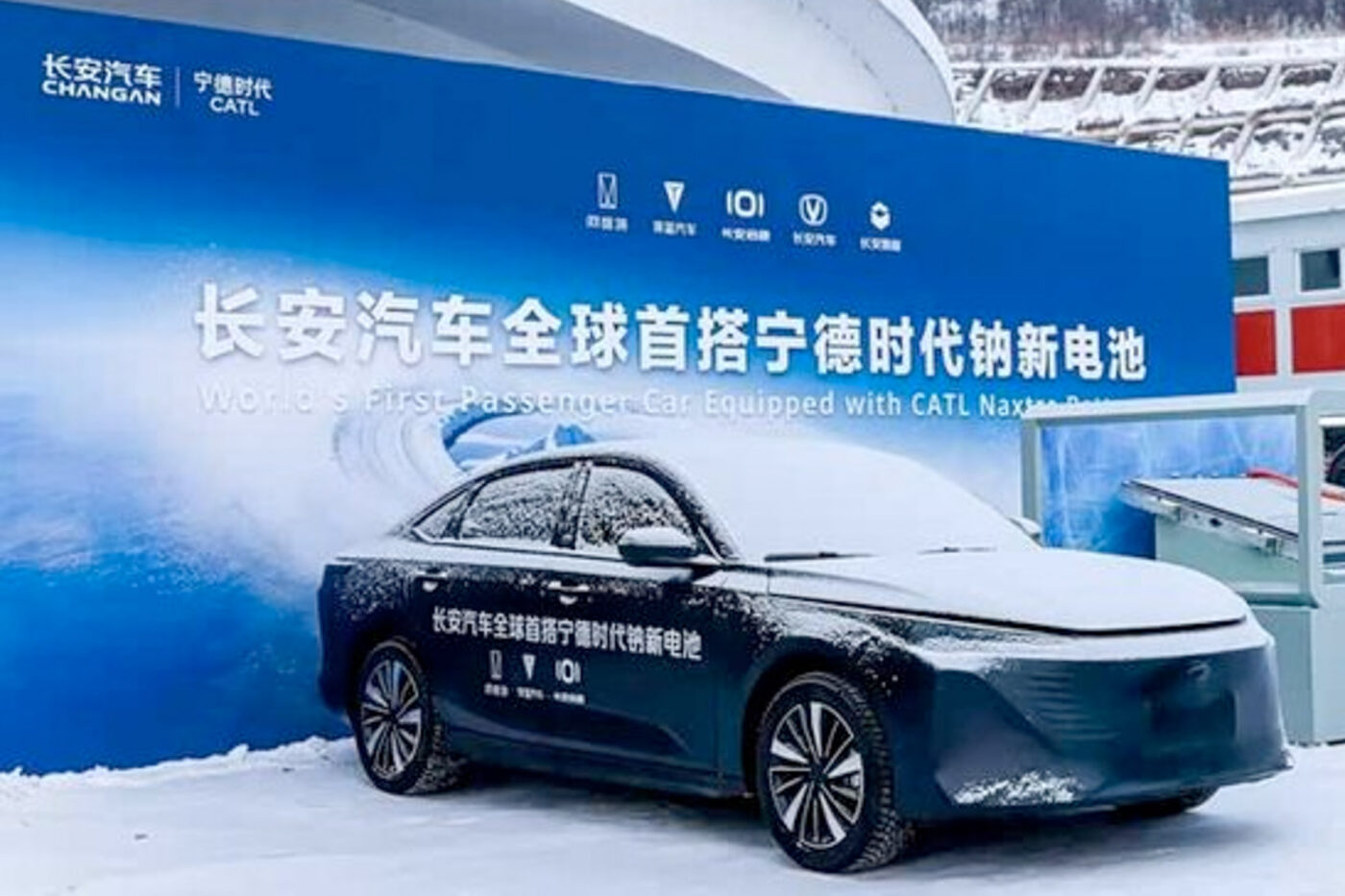
This vehicle is an existing sedan with a length of 4.88 metres and a wheelbase of 2.92 metres, which the Changan brand Qiyuan (known as Nevo outside China) already offers with battery-electric drivetrains and as a range-extender model. It uses LFP battery cells from CATL (EREV) and Gotion (BEV), with energy capacities ranging between 23.4 and 63.2 kWh.
The recently unveiled variant of the Changan Qiyuan A06 is, according to announcements from China, “the world’s first mass-produced passenger vehicle with a sodium-ion battery.” While Changan and CATL claim that previously released electric vehicles with sodium-ion batteries did not meet mass-production criteria, exceptions exist. For example, the JAC-owned brand Yiwei launched a compact car with sodium-ion batteries in early 2024; the cells were supplied by Hina Battery. However, its production volumes remained limited.
45 kWh for 400 kilometres of range
It remains to be seen what production volumes the Qiyuan A06 with sodium-ion batteries will achieve. The vehicle is equipped with a 45 kWh battery, which is expected to deliver a range of over 400 kilometres under the Chinese CLTC standard. The WLTP test cycle, commonly used in Europe, typically results in higher energy consumption and thus lower ranges.
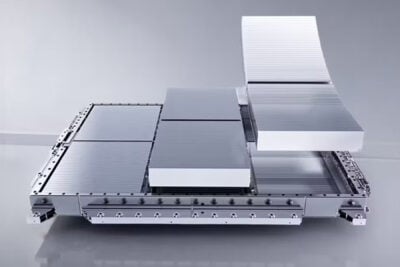
CATL’s first mass-produced passenger car with a sodium-ion battery is thus equipped with a battery pack of the same capacity as the sodium-ion battery it previously introduced for light commercial vehicles. While the design of the battery packs may differ slightly, the cell chemistry is likely identical. The sodium-ion cells from CATL’s Naxtra brand currently achieve an energy density of 175 Wh/kg and are designed as a cell-to-pack system without battery modules.
CATL has previously emphasised the rapid development and learning curve of sodium-ion batteries in recent months. The company expects that battery-electric vehicles using this technology will soon achieve ranges of 500 to 600 kilometres (under CLTC), while range-extender vehicles could reach over 300 kilometres of all-electric range. This would bring sodium-ion cells roughly in line with today’s LFP batteries.
CATL envisions a “new era of dual chemistry”
This is also evident in the Changan Qiyuan A06: the two battery-electric variants with LFP cells from Gotion offer energy capacities of 51.5 and 63.2 kWh, providing norm ranges of 510 and 620 kilometres, respectively. These are precisely the values CATL is targeting for its sodium-ion technology in the future. According to the battery manufacturer, such batteries could cover “over 50 percent of the range requirements in the new energy vehicles market.”
“The arrival of sodium-ion technology marks the beginning of a dual-chemistry era. CHANGAN’s vision shows both its responsibility for energy security and its strategic foresight,” says Gao Huan, CTO of CATL’s Chinese electric vehicle business. “At CATL, we value the opportunity to work alongside such an industry leader and fully support its strategy, combining our expertise to bring safe, reliable, and high-performance sodium-ion technology to market.”
When Changan and CATL sent an Oshan-branded passenger car model from Changan with Naxtra sodium-ion batteries for winter testing at the end of January, it was already clear that a mass-production launch was imminent. However, the portal CarNewsChina initially speculated that it might be the Changan Oshan 520, as this model is already equipped with CATL’s battery-swapping system.
According to Changan, the battery confirmed its “exceptional performance” during extensive winter testing. “Test data revealed that the vehicle’s discharge power at -30℃ is nearly three times higher than conventional lithium iron phosphate (LFP) models of the same capacity. Furthermore, the battery maintains over 90% capacity retention at -40℃ and can stably discharge even in extreme conditions as low as -50℃,” reports CarNewsChina. These findings closely match the values previously stated by Naxtra for its ‘Tectrans II’ commercial vehicle battery.
0 Comments