


China: FAW advances solid-state batteries
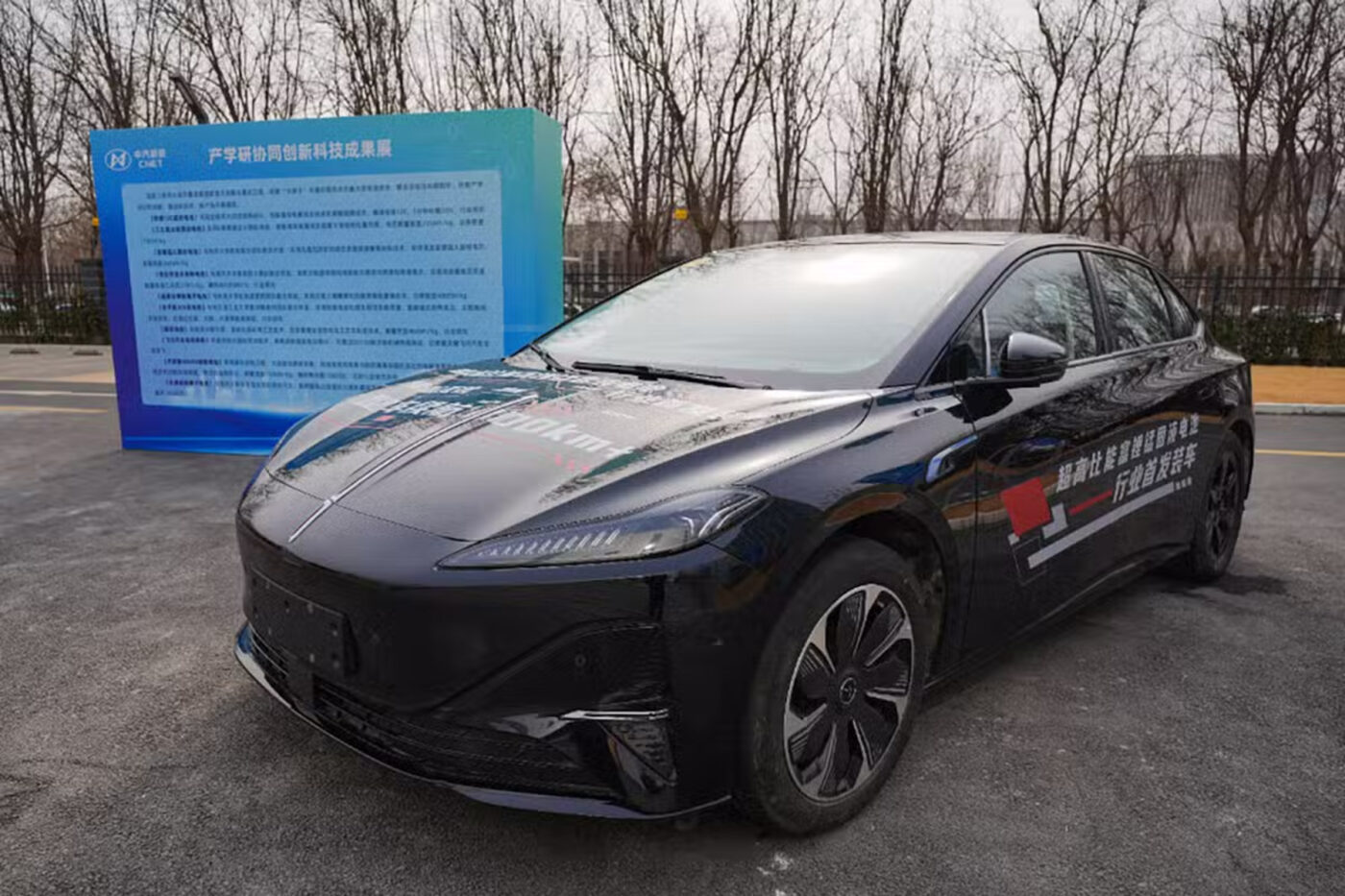
The battery pack installed in the prototype offers an energy capacity of 142 kWh and, according to the Chinese CLTC standard, a range of well over 1,000 kilometres. However, its size and weight remain unknown at this stage. Chinese media reports indicate that the energy density of the individual cells exceeds 500 Wh/kg.
At this energy density, the cells in this battery pack would weigh approximately 285 kilogrammes. However, this figure does not represent the total weight of the entire battery pack, which includes structural elements, the thermal management system, wiring, and control units.
The new battery is noteworthy not only for its energy density. Other semi-solid-state batteries are typically modified versions of existing NMC or NCA cell chemistries, in which the liquid electrolyte is replaced by a semi-solid hybrid electrolyte. While this approach improves factors such as energy density and safety—and ensures compatibility with existing production lines—it may not fully exploit the advantages of semi-solid-state technology.
In contrast, the new battery from CANEB is said to be the first application of a lithium-rich manganese-based semi-solid-state battery. “The battery uses in-situ-cured composite electrolyte technology, which provides high ionic conductivity, a wide electrochemical window, strong interfacial compatibility, flame retardancy, and cost advantages,” writes the portal CarNewsChina. “It also incorporates an in situ-formed lithium negative electrode, avoiding the risks and costs of metallic lithium anodes while improving cycle life and safety.” The manufacturer states the cathode capacity as 300 mAh/g.
As is often the case with prototype batteries, not all data is available, and these remain prototypes—details may still change before potential series production. However, CANEB and FAW have progressed from cell laboratory testing to vehicle trials. These trials will assess not only the cells and their behaviour within the installed battery pack but also necessary adaptations to the vehicle platform, such as thermal management and power electronics, due to the different cell technology and higher energy throughput.
The development vehicle now presented belongs to FAW’s Hongqi brand. This is unsurprising, as in early January, Hongqi announced the start of real-world vehicle testing of solid-state batteries—specifically in a Hongqi Tiangong 06. At the time, the FAW premium brand stated it was the first complete all-solid-state system to be installed in a production vehicle. As there was no mention of an ‘all-solid-state battery’ with a completely solid electrolyte, this statement also applies to the semi-solid-state technology now presented in greater detail.


0 Comments