


Steyr Automotive to assemble electric and diesel trucks for Sinotruk
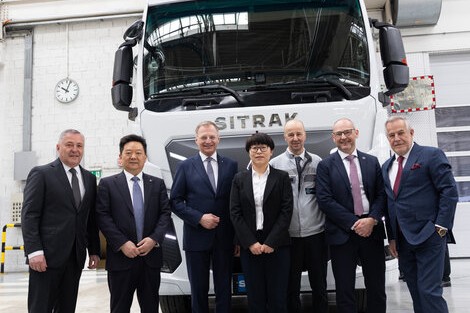
According to Steyr Automotive, Sinotruk and the Austrian manufacturer have signed a contract for the assembly of trucks. The first vehicle was completed earlier this week. “Initially, assembly will be carried out using SKD construction methods. As production volumes increase, there are plans to expand to CKD production, which will also include cab manufacturing and painting in Steyr,” Steyr Automotive announced.
In other words: currently, partially assembled truck kits imported from China are being assembled at the Austrian plant (SKD, Semi Knocked Down). However, the goal is to transition to CKD assembly (Completely Knocked Down) at a later stage, where trucks arrive in Austria as individual parts and are fully assembled there. This strategy will create more jobs in Steyr, as cab production and painting will also take place locally.
Details on the powertrain mix stay under wraps
What stands out is that Sinotruk has commissioned Steyr Automotive to assemble both diesel and electric trucks. However, the companies have not specified the exact powertrain mix. Steyr Automotive’s statement remains general, describing the collaboration as including the provision of ‘state-of-the-art’ manufacturing processes, infrastructure, and capacities at the Steyr site. At least the target regions for the units produced in Steyr have been named: these will be delivered to customers in the EMEA region—Europe, the Middle East, and Africa.
According to information from the German Kronen-Zeitung, between 600 and 800 units are expected to be built at Steyr Automotive this year. However, this figure has not been officially confirmed. Technical details about the trucks also remain undisclosed. In China, Sinotruk markets its NEV trucks primarily under its Howo brand. The electric tractor unit featured on the manufacturer’s official website measures 5.99 x 2.17 x 3.10 metres and is equipped with LFP batteries from CATL or Fudi. However, this model is primarily intended for the Chinese market.
MAN technology as possible basis
Meanwhile, the portal Eurotransport reports that the first Sinotruk truck completed in Steyr this week is a 4×2 diesel tractor unit featuring a visually modernised cab from the MAN TG2. The model bears the Sitrak brand name on its bonnet. The portal suggests that the TG2 could provide the complete technical basis for the Sinotruk truck—specifically, the diesel version.
This would not come as a surprise: MAN maintains close ties with Sinotruk, holds a stake in the Chinese company, and, according to Eurotransport, supplies ‘technologies for at least some Sinotruk models.’ Furthermore, the connection to Steyr Automotive is straightforward: the Austrian company operates the former MAN plant in Steyr and continues to supply components to MAN.
The new contract will bring more activity to the Austrian facility. Just a few months ago, Steyr Automotive secured a fixed contract to build the eTopas 600 electric truck—a model from the Chinese startup SuperPanther. “The production of Sinotruk vehicles expands its customer base in the contract manufacturing business,” the company stated.
Previously, Steyr Automotive had also planned to assemble the battery-electric Volta Zero truck. However, the client, Volta Trucks, went bankrupt, and this project never progressed beyond the preparatory phase.
Turning our attention to Sinotruk’s position in China: The company’s full name is China National Heavy Duty Truck Group. Based in Jinan, Shandong Province, the group offers a wide range of commercial vehicles, including heavy, medium, and light-duty trucks, buses, and specialised vehicles. Sinotruk is considered the largest manufacturer of heavy-duty trucks in China and sold approximately 245,000 vehicles in 2024, accounting for 27% of the domestic market. The company also sold 6,166 trucks with alternative powertrains, including battery-electric and fuel cell electric vehicles.
In recent years, Sinotruk has become particularly known for its collaboration with Toyota to develop fuel cell commercial vehicles for China, as well as a major order for 1,100 hydrogen-powered trucks. In September 2022, three companies placed this order with Sinotruk and Weichai Power. The order is expected to take two to three years to complete. The three customers were Qingdao Shengtonghua Automobile Sales & Service, Zibo Zhanhong Automobile, and the logistics company Tongxin Logistics Technology. Weichai Power, in turn, entered into a strategic partnership with fuel cell manufacturer Ballard Power Systems in 2018 and has since become Ballard’s largest individual shareholder. The supplier is part of Sinotruk’s close partner network.
While Sinotruk is a long-established manufacturer now venturing into Europe with both diesel and electric trucks, other Chinese OEMs currently eyeing the European market have different backgrounds. Windrose and SuperPanther, for instance, are startups founded just a few years ago, specialising in electric trucks and never having been part of the diesel sector. As a result, they cannot rely on revenue from diesel sales but must succeed immediately with their electric trucks. SuperPanther is also pursuing the contract manufacturing route with Steyr Automotive and plans to launch series production this summer. By the end of 2026, SuperPanther aims to deliver the first 100 to 200 units to customers.
Windrose, on the other hand, established itself at the Belgian port of Antwerp-Bruges earlier this year and plans to assemble electric trucks for the European market there, as well as set up research and development and aftersales departments. No details about the assembly timeline have been disclosed yet.
A fourth Chinese player eyeing Europe is Sany. As a construction machinery giant, Sany is a well-established name. The company aims to enter the European market with its electric tractor units and chassis through the German company Putzmeister. Sany originally planned to start deliveries of its e263 electric tractor unit in early 2026, but this has not yet materialised.
steyr-automotive.com, krone.at, eurotransport.de (last teo in German)
0 Comments