


UK logs record EV registrations in March
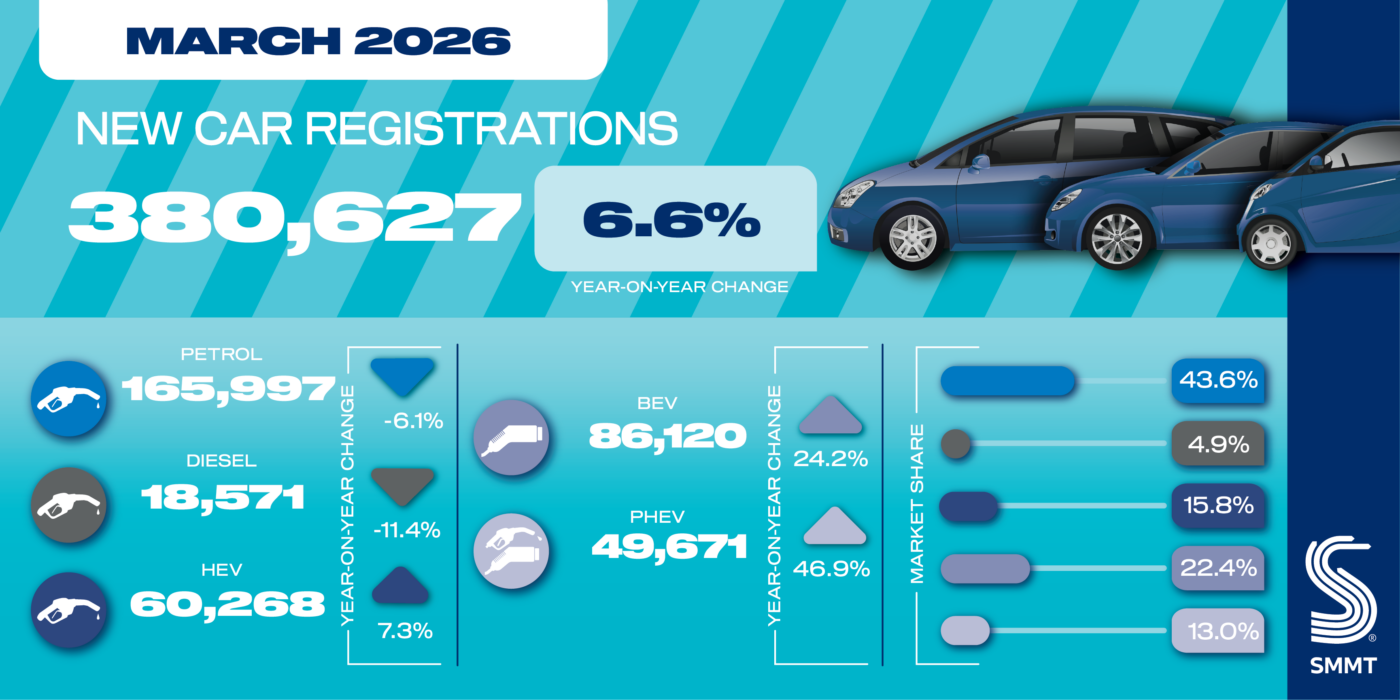
The UK automotive market recorded its strongest performance since 2019 in March 2026, with 380,627 new car registrations, according to the Society of Motor Manufacturers and Traders (SMMT). The 6.6% increase in what is traditionally the busiest month of the year was driven primarily by private demand, which rose 10.1% to 162,470 units. Fleet registrations increased by 3.5% to 208,853 units, while business demand climbed 18.8% to 9,304 units.
Electrified vehicles reached their highest-ever monthly volume, with a combined 196,059 registrations across battery electric, plug-in hybrid and hybrid models. Battery electric vehicles recorded a new monthly high of 86,120 units, up 24.2% year-on-year, while plug-in hybrid vehicles rose 46.9% to achieve a 13.0% market share. Hybrid electric vehicles increased by 7.3%, taking a 15.8% share.
Despite record BEV volumes, their market share stood at 22.6% in March and 22.4% year-to-date, remaining significantly below the 33% target set under the UK’s Zero Emission Vehicle (ZEV) mandate for 2026. According to SMMT, the gap highlights ongoing challenges in scaling demand in line with regulatory requirements.
Market conditions have diverged from earlier assumptions underpinning the mandate. Battery costs at the start of 2026 were reported to be more than 30% higher than expected, the SMMT stated, while industrial energy prices remained around 80% above 2021 levels. Public charging costs have also increased significantly, rising by more than 140% over the past five years.
Moreover, the trade associations stressed that geopolitical developments have added further uncertainty. The ongoing Iran crisis is expected to affect both consumer sentiment and supply chains. Fuel prices have already been affected; however, the SMMT stipulates that the cost of living will also rise. While some factors may increase interest in electric mobility, others risk dampening demand.
Nevertheless, manufacturers continue to invest heavily in electrification, with more than 160 EV models now available in the UK market, the SMMT stated. However, the trade association also noted that carmakers are relying on significant discounting to stimulate uptake and meet regulatory thresholds.
“The strongest new car market since 2019, with the highest ever volume of EV registrations, is a boost to the industry and the economy,” said Mike Hawes, Chief Executive of the SMMT. “However, the headlines belie the costs incurred and the challenges involved.”
He added: “Much of March’s performance will be from orders placed before the start of the Iran conflict, which threatens to raise the cost of living, undermining consumer confidence. Against this backdrop, and with the EV market falling further away from mandated levels despite record levels of incentives, an urgent review of the transition is required to secure a sustainable market, economic growth and the UK’s net zero ambitions.”
The UK’s ZEV mandate requires an increasing share of new car sales to be electric each year until 2035. The mandated share is set to rise steeply to 80 per cent by 2030. However, at the end of 2025, the UK started reviewing the policy, bringing the process forward from 2027 after sustained pressure from the automotive industry.
Meanwhile, the UK government recently introduced the Electric Car Grant (ECG), offering subsidies of up to 3,750 pounds for qualifying EVs to boost demand.
Update 9 April 2026
The UK light commercial vehicle market. tells a completely different story. According to the latest figures from the SMMT, 3,543 electric vans were registered in March. That means electric van uptake fell 15.9%.
This corresponds to a market share of just 7.1%, the lowest level since September 2024 and significantly below the 24% zero-emission share mandated for 2026. Across the first quarter, battery electric vans accounted for 9.0% of registrations, underlining the widening gap between regulatory targets and market reality.
As usual, the SMMT points to several structural challenges. These include higher upfront purchase costs compared to diesel vehicles, limited availability of depot charging infrastructure and a lack of suitable public charging options for commercial vehicles. As a result, diesel continues to dominate the market, accounting for more than 85% of new registrations.
Nevertheless, industry representatives warn that current progress is insufficient to meet mandated targets. Mike Hawes, Chief Executive of the SMMT, stated: “It is increasingly alarming to see BEV demand waning when it must accelerate to reach ever-tougher mandated levels.”
He added: “With the transition already falling behind schedule, a holistic review of the transition is urgently needed.”


2 Comments