


i-charging unveils 500 kW charging system for cars and trucks
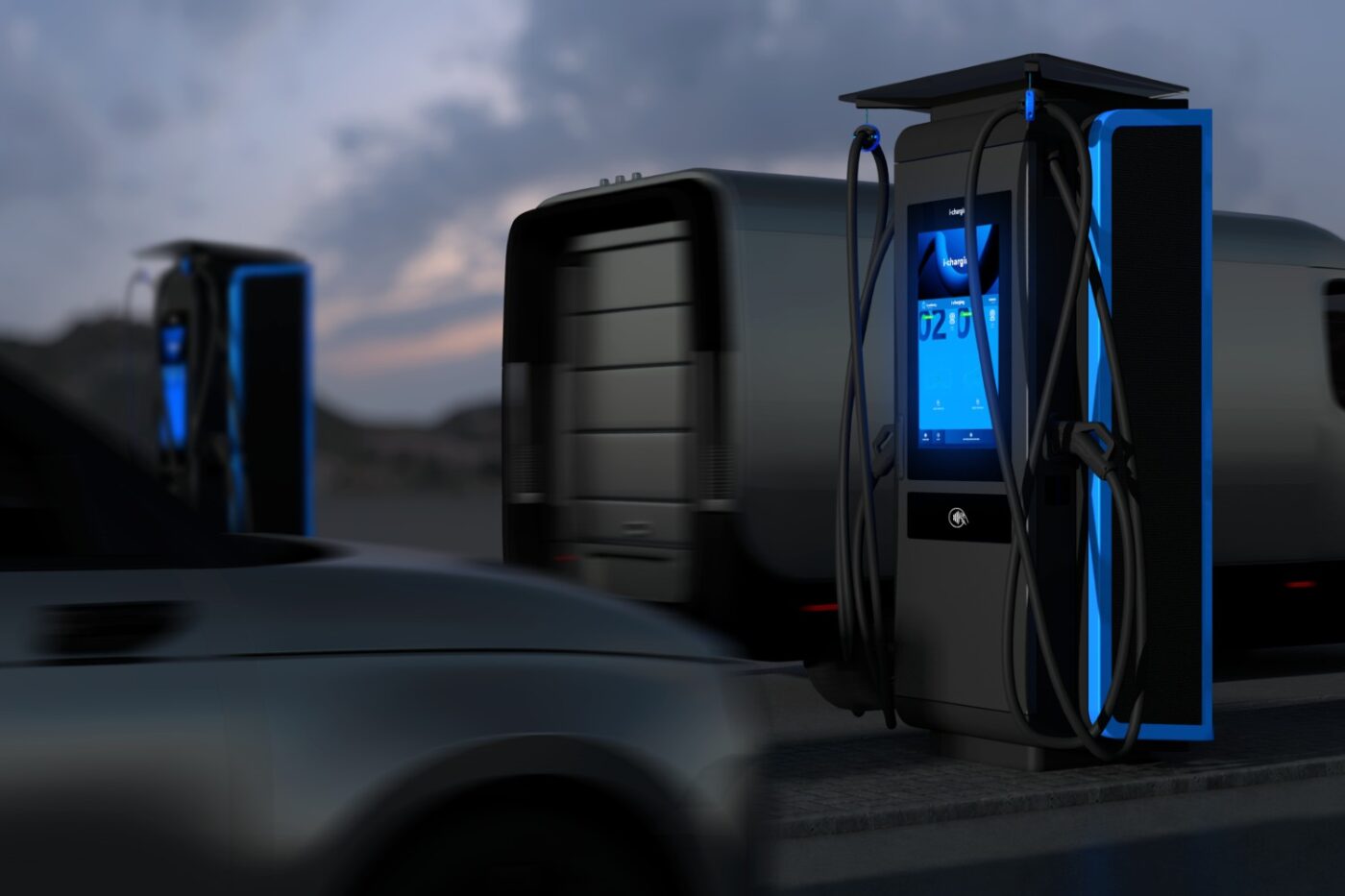
According to i-charging, the new standalone system delivers up to 500 kW at 1,000 volts from a compact charging unit. The charging station features two connectors and can dynamically distribute the available charging power between the two charging points. As an option, the Portuguese manufacturer offers liquid-cooled charging cables and the possibility to combine two charging standards — CCS, NACS or GB/T — within a single unit. For example, a station can be configured with both a CCS and an NACS connector.
The manufacturer said the system was designed for motorway corridors, filling stations and urban locations where high vehicle density coincides with limited available space. i-charging plans to start deliveries of the AiO 500 in initial European markets by the end of 2026, followed by North America in the first quarter of 2027 and markets with metrology requirements, including Germany.
For dynamic power distribution, the Portuguese company uses its own patented technology. In the AiO 500, the available power can be distributed across the connected charging points in 100 kW increments. This happens in real time and on demand, as the company’s representatives explain: “When two vehicles are connected, power is allocated based on what each can receive at that moment. If one vehicle requires higher power than the other, the system adjusts accordingly.” According to the company, this approach optimises the use of the installed total capacity and keeps charging times short for customers.
i-charging distinguishes between a standard version and one with liquid-cooled cables. The former supports up to 500 amperes, while the latter supports up to 800 amperes. The liquid-cooling option, according to the manufacturer, enables heavy-duty charging processes on the AiO 500. The reason: “Commercial and heavy-duty vehicles require higher sustained current over longer periods than standard cables can reliably deliver. With liquid-cooled cables, the AiO 500 is suited to freight, coach and heavy transport operations alongside passenger vehicle charging, from a single compact unit,” i-charging states.
The unit is operated, as is customary for the Portuguese manufacturer, via a 32-inch touchscreen. Additionally, the charging station includes a contactless card reader and, optionally, a bank card terminal. The AiO 500 also supports Plug&Charge and Autocharge functions and operates via the OCPP 1.6 and 2.0.1 protocols. The device can be networked via a 4G modem or Ethernet.
According to Pedro Moreira da Silva, CEO of i-charging, the 500 kW charging threshold is becoming increasingly relevant as more production electric vehicles support charging capacities of 400 kW or more. He said conventional all-in-one chargers with a 500 kW limit can dedicate the entire installed capacity to a single vehicle, whereas the AiO 500 was developed to provide high charging power simultaneously through both outputs.
Moreira da Silva also highlights that the company’s standalone solutions have always prioritised space-saving designs. “With the all-in-one 500, we are taking that further. While distributed solutions like our MAX, scaling up to 1600 kW across multiple power units, remain the reference for high-output multi-plug sites, the all-i-one 500 answers a different challenge: maximum power in a
minimal footprint, for sites where space simply doesn’t allow a distributed installation.”
The aforementioned power supply unit named MAX, with up to 1.6 MW of power, was introduced by i-charging a quarter of a year ago. It enables the simultaneous charging of up to eight electric vehicles—also with dynamic power allocation. However, unlike the AiO 500, the MAX system uses a split-unit design: a central power unit supplies the necessary direct current to multiple connected charging stations.
Source: Information via e-mail, i-charging.tech
0 Comments