


Schaffhausen breaks ground on charging hub for electric regional buses
Due to extensive construction work in the city centre, the Schaffhausen Transport Authority (vbsh) has brought forward the originally planned phase-out of trolleybuses from 2029 to December 2025. Following the 2024 order of six battery-electric articulated buses from the Spanish manufacturer Irizar, these will replace the last trolleybuses in Schaffhausen—the end of an era.
However, Schaffhausen’s shift to battery-electric buses is not limited to urban transport. The regional transport network is also set to transition from diesel vehicles to battery-electric buses, with the aim of significantly reducing CO₂ emissions and improving air quality.
To this end, vbsh ordered 13 battery-electric solo buses, the eCitaro, from Daimler Buses at the end of 2024. As the public transport operator refers to these as standard buses, this likely means the classic configuration: a 12-metre length with capacity for up to 88 passengers.
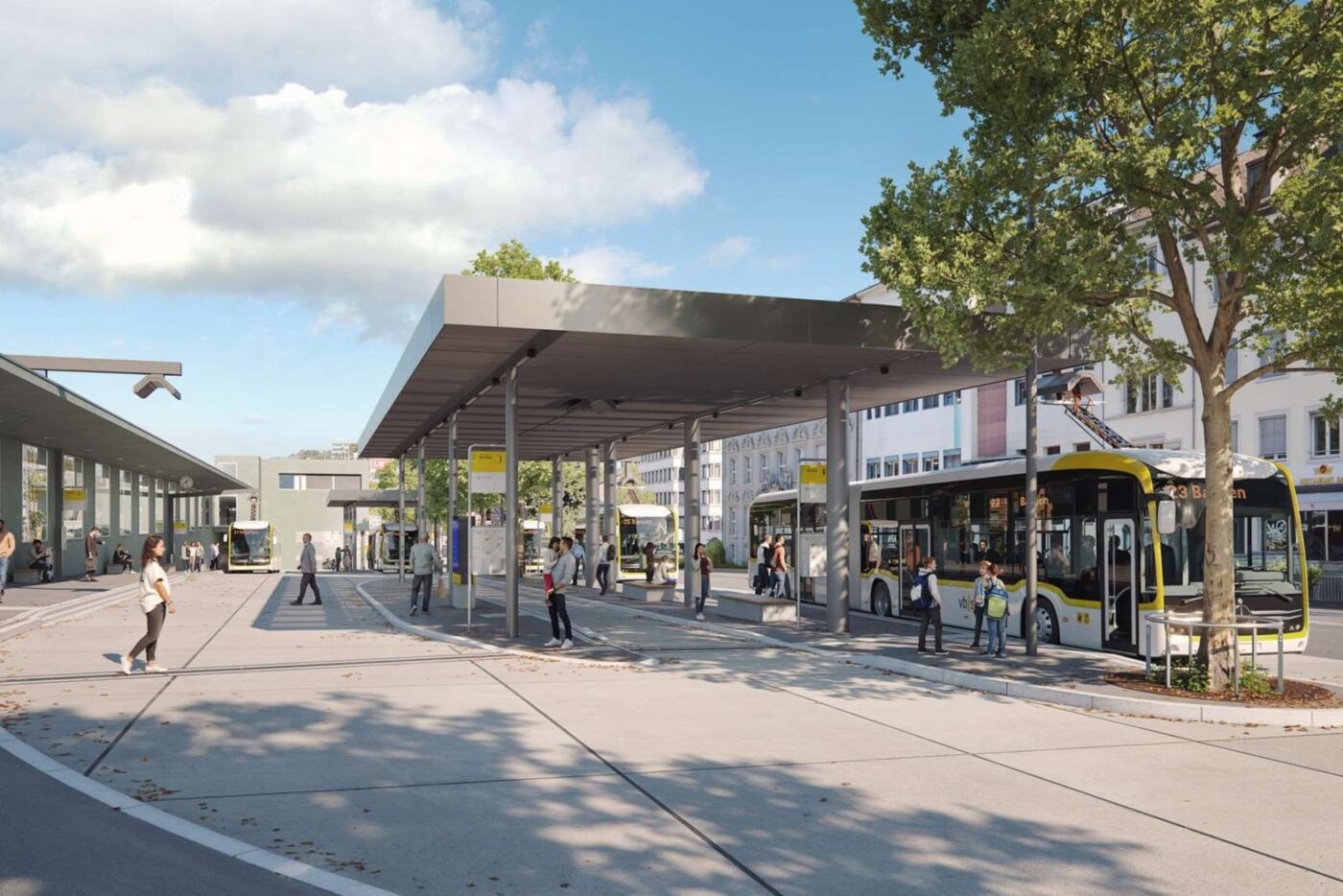
To prepare for the launch of these battery-electric buses, construction of the regional bus centre at Schaffhausen railway station will begin on 2 March, with completion scheduled for summer 2027. During the same period, additional overnight charging stations will be installed at the new Ebnatring depot, according to vbsh.
Opportunity charging at the railway station
The charging concept is based on opportunity charging. While stopped at Schaffhausen railway station, the future battery-electric buses will top up their batteries using a pantograph (current collector). Overnight, they will be fully recharged at the depot using a “gentle” charging process, which likely refers to lower charging power.
For these intermediate charging sessions, seven pantograph-compatible fast-charging points and a transformer station will be constructed at the regional bus centre. The new charging points, primarily made of steel, will be integrated into the bus roofs and feature charging hoods with a power output of 270 to 540 kW, similar to those at Bahnhofstrasse, where the city buses recharge.
Accessibility upgrades
As part of the conversion, the regional bus centre will also be redesigned to be fully accessible. The platform edges will be raised from 16 to 22 centimetres, enabling step-free boarding for battery-electric buses and allowing wheelchair users and prams to board without obstacles.
The investment for the electrification amounts to 7.5 million Swiss francs, which will be covered by vbsh. The City of Schaffhausen will contribute 1.3 million Swiss francs for the accessibility upgrades, in accordance with the Swiss Disability Equality Act (BehiG).
vbsh.ch, tagesanzeiger.ch (both in German)

0 Comments