


Rhenus tests H2 truck in regular operations
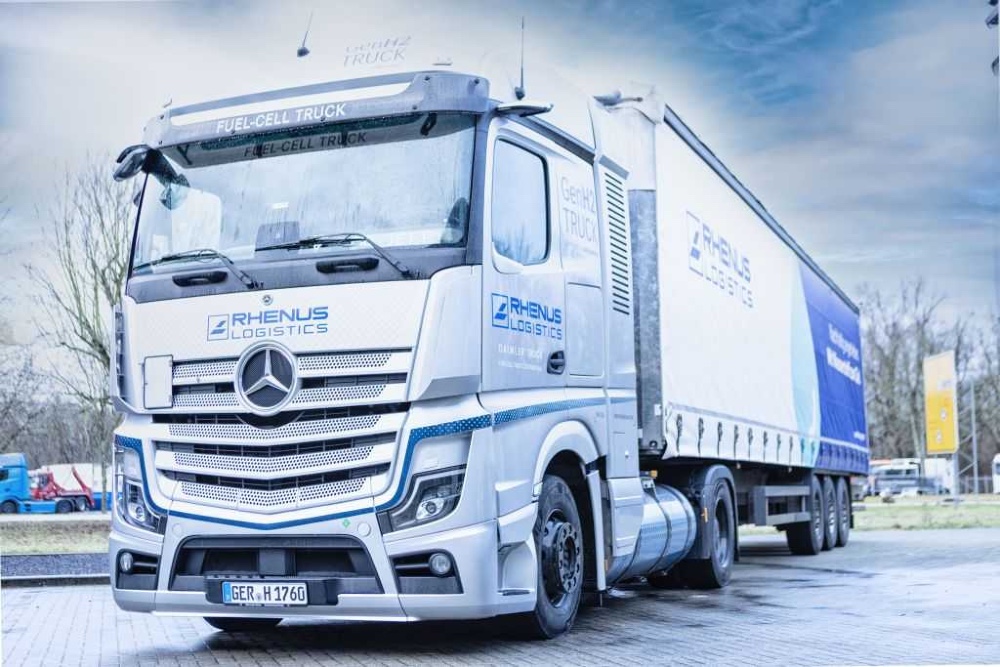
Both the vehicle developers at Daimler Truck and the Rhenus Group expect to gain valuable insights from the trial to inform the further development of the truck and the future use of hydrogen in freight transport. The pre-series vehicle, powered by liquid hydrogen, is stationed at the Duisburg site and is ‘fully integrated into day-to-day processes,’ as Rhenus states.
That means the GenH2 Truck is used in regular operations five days a week, both day and night. As a result, the vehicle is on the road in real logistics operations almost around the clock, according to those responsible.
The routes include regional trips (covering around 150 kilometres) as well as long-distance assignments with distances of up to 650 kilometres. The practical test is intentionally designed to cover a wide range of transport requirements—from classic distribution traffic to demanding long-haul routes.
“Thanks to high utilisation and diverse transport profiles, the truck achieves exceptionally high daily mileage,” the German logistics provider highlighted. Rhenus is thus among the partners with particularly extensive testing experience.
How does the GenH2 compare to diesel?
For Rhenus, the focus this year is primarily on operational experience in daily use—such as the refuelling process, range, and refuelling times compared to diesel trucks. The Duisburg site was deliberately chosen as the testing ground. It serves as both a central hub in Rhenus’ European logistics network and is equipped with a suitable hydrogen refuelling infrastructure—a basic prerequisite for the test deployment.
This is also why current customer trials for the GenH2 Truck are concentrated in just a few regions. To date, there are only two filling stations nationwide that can supply the liquid hydrogen (“sLH2”) required for Daimler Truck’s H2 pre-series vehicles. More on this below.
Nearly two years ago, Daimler Truck launched the first customer-oriented testing phase for its future H2 truck. At the end of 2025, the second phase followed as planned, with real-world customer tests involving five partner companies. In addition to Rhenus, these include Hornbach, Reber Logistik, Teva, and DHL Supply Chain.
Each customer has received one vehicle to deploy on their regular logistics routes within Germany. The tests, initiated in summer 2024, were initially customer-oriented trials. However, the demands on the fuel cell truck have since increased—such as temperature-controlled pharmaceutical transports or general cargo shipments in international long-haul transport.
Small series of 100 tractor units planned
As the next step, the German manufacturer plans to produce a small series of fuel cell trucks. Daimler Truck has already begun the development phase for the next generation.
“As part of a small-series production, a total of 100 tractor units are to be built at the Mercedes-Benz plant in Woerth and put into customer operations starting at the end of 2026,” the company announced in November. However, regular series production is not expected before 2030. Daimler Truck is under immense pressure and announced a cost-cutting programme in summer 2025, which includes the deprioritisation of the GenH2 Truck. As a result, the planned series production was postponed from its original 2027 target to the early 2030s.
“However, the expansion of hydrogen refueling infrastructure is progressing significantly slower than expected. As a result, customers will not be able to deploy hydrogen trucks in large numbers in the next few years,” Daimler Truck recently emphasised.
In addition to delaying the start of series production, the group also expects a lower volume. Furthermore, the Stuttgart-based company is initially focusing on the development of hydrogen powertrains solely in Europe. For the European domestic market, the dual strategy with battery-electric and hydrogen-powered vehicles thus remains in place. This is not necessarily the case for other markets.
Daimler Truck first announced its plans to develop and build a fuel cell truck in 2020. The first customer-oriented testing phase involved Air Products, Amazon, Holcim, Ineos, and Wiedmann & Winz.
Here, too, five vehicles were deployed, which, according to the company, covered a total of around 225,000 kilometres. Hydrogen consumption varied between 5.6 kilograms and 8.0 kilograms per 100 kilometres, depending on the application, with an average gross combination weight of between 16 and 34 tonnes.
Fuel cell system supplied by Cellcentric
Now, Rhenus and the four other partner companies are taking over in the second phase. A brief look at the model’s technology: The core of the GenH2 Truck consists of two fuel cell systems from the joint venture Cellcentric, with a system output of 300 kW (2x 150 kW). A 70 kWh battery provides an additional temporary boost of up to 400 kW, used during peak loads such as acceleration or hill climbs.
The two electric motors are designed in a pre-series version for a continuous output of 2 x 230 kW and a peak output of 2 x 330 kW. Torque is rated at 2 x 1,577 Nm and 2 x 2,071 Nm, respectively.
Daimler Truck also highlights the cooling and heating system as a core element of the powertrain, forming part of the sophisticated operating strategy for the fuel cell and battery system. By maintaining all components at the optimal operating temperature, the system’s longevity is expected to increase.
With a gross vehicle weight of around 40 tonnes, the GenH2 Truck offers a payload of approximately 25 tonnes. The only energy source used is liquid hydrogen (sLH2). As a result, the testing of the GenH2 Trucks is far more dependent on infrastructure than battery-electric trucks: currently, the vehicles can only be refuelled at two dedicated sLH2 filling stations in Wörth am Rhein and the Duisburg area. The partner for these filling stations is Linde. Liquid hydrogen, as opposed to gaseous hydrogen, enables the hydrogen truck to achieve a range of over 1,000 kilometres, as Daimler Truck demonstrated in September 2023: a road-approved prototype covered 1,047 kilometres on a single tank.
“Particularly in energy-intensive heavy-duty and long-haul transport, we see significant potential in hydrogen-powered trucks”, says Thilo Meutzner, Managing Director of Rhenus Road Freight in Germany. “The field test helps us realistically assess the conditions under which this technology could be adopted on a broader scale in the future.”
However, it is already clear that a market ramp-up, ‘will depend heavily on expanding refuelling infrastructure, ensuring the availability of green hydrogen and establishing competitive cost structures.’
0 Comments