


Toyota to join Cellcentric as third shareholder
Toyota is one of the pioneers and one of the few remaining committed developers of fuel cells for passenger cars. Just over a year ago, the Japanese company unveiled its third-generation fuel cell system, which is suitable for use in passenger cars but can also be integrated into larger vehicles, ships and stationary applications.
Toyota now plans to join Cellcentric, the fuel cell joint venture focused on heavy-duty commercial vehicles, formed by Daimler Truck and the Volvo Group (not to be confused with the car manufacturer Volvo Cars). This focus will remain unchanged even after Toyota’s entry: “All three shareholders intend to further strengthen cellcentric as a leading manufacturer of fuel cell systems for heavy-duty commercial applications,” Daimler Truck stated.
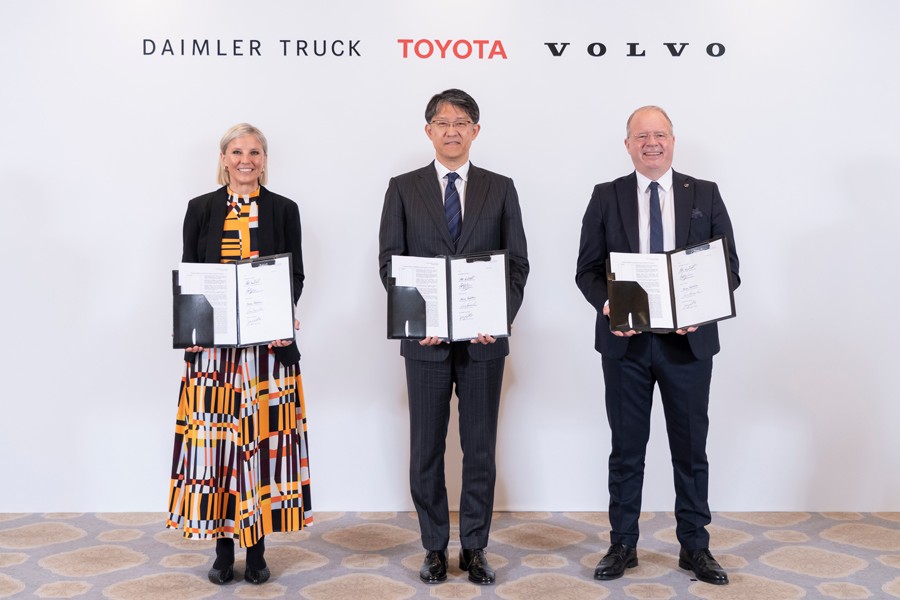
However, Toyota’s onboarding is not yet official. All three OEMs and the joint venture recently signed a letter of intent, with a binding contract to follow. The partners did not specify when the entry might be finalised. At this stage, all parties are primarily emphasising the complementary strengths that the joint venture is expected to leverage in the future.
Cellcentric was founded in 2021 by Daimler Truck and the Volvo Group as a joint venture to produce fuel cells for heavy-duty commercial vehicles. The company is building a factory for this purpose in Weilheim an der Teck in southern Germany, though its completion has been delayed.
The reason: while Daimler Truck’s GenH2 Truck is already undergoing customer testing, the manufacturer has postponed series production of fuel cell electric trucks from the end of this decade to the 2030s. Volvo is also unlikely to begin before the end of this decade. As a result, fuel cell systems will be needed later than initially anticipated, prompting Cellcentric to revise its plans.
Toyota’s entry now adds a new dynamic to the development. In recent years, the Japanese company has gradually shifted away from its decades-long focus on passenger cars in the hydrogen sector. For example, it announced a fuel cell bus with Isuzu, Toyota is testing a quartet of fuel cell trucks with VDL, and the company is accelerating the roll-out of heavy-duty hydrogen trucks in China with Sinotruk.
That is just a snapshot of its activities in this area. With its planned entry into Cellcentric, Toyota is moving even closer to the commercial vehicle sector. The goal is to focus on “fuel cell systems for heavy-duty commercial vehicles and other heavy-duty applications with comparable requirements.”
Furthermore, Toyota and Cellcentric announced their intention to ‘jointly manage the development and production of fuel cell unit cells — the core component of fuel cell systems — and directly linked architecture and control elements with the aim of creating competitive products based on the technologies of both companies.’ The aim is to develop competitive products that optimally utilise the technologies of both companies. However, the partners did not provide further details at this stage.
Karin Rådström, President & CEO of Daimler Truck, kept her statement relatively general: “We are proud that Toyota plans to join cellcentric as a shareholder. This will enable us to strengthen development and further scale hydrogen technology, which we believe complements battery-electric drives in decarbonising transport.”
Andreas Gorbach, Member of the Board of Management of Daimler Truck, added: “Joining forces with the world’s largest automotive manufacturer and fuel cell pioneer is a privilege for us – and a game changer in making hydrogen in transportation a reality and cellcentric the go‑to place for fuel‑cell technology in commercial vehicles worldwide.”
Martin Lundstedt, President and CEO of the Volvo Group, commented: “We are thrilled to explore this collaboration with Toyota, so that we through cellcentric can accelerate and create critical mass for hydrogen applications. This is an important signal to customers, suppliers, and others in the ecosystem. Given the importance of accelerating the transformation into net-zero transportation, the need of great companies coming together and collaborating is more important than ever. Welcoming Toyota onboard will be a big leap towards realising decarbonisation of our industries.”
Unsurprisingly, Toyota’s CEO also weighed in: “We are deeply grateful for the opportunity to soon be joining Daimler Truck and Volvo Group as partners in building a hydrogen society. cellcentric which possess deep expertise in commercial fields together with Toyota ‘s over 30 years of fuel-cell development in the passenger car sector, can combine their strengths to deliver one of the world-leading fuel cell systems for heavy commercial vehicles. Toyota will continue to contribute to realising a hydrogen society alongside like-minded partners.”
Importantly, all parties aim for an equal partnership with Toyota. The joint venture is expected to continue operating as an independent and autonomous company, serving a broad range of customers. To achieve the desired ownership structure, Toyota plans to participate in Cellcentric through a capital increase and invest in the company.
“Daimler Truck, Volvo and Toyota will continue to compete independently in all other areas of their respective businesses,” the trio assured, though they are convinced that such large-scale collaborations are necessary ‘to secure hydrogen fuel cells as one of the key technologies to support the decarbonisation of transport worldwide.’
According to Daimler Truck, the recently signed letter of intent will now be followed by discussions with the clear goal of finalising a legally binding agreement.
Nicholas Loughlan, CEO and CTO of Cellcentric, warmly welcomed the move: “We are extremely proud that Toyota intends to join as a shareholder of cellcentric – a great sign of trust in our company from one of the world‘s leading automotive companies. Together, in this new set-up, we look forward to seizing the opportunity to significantly improve our company across the entire value chain.”
Currently, Loughlan leads a team of around 560 employees, who, according to the company, work in interdisciplinary teams across sites in Kirchheim/Teck, Esslingen, Stuttgart and Burnaby (Canada). To date, Cellcentric holds around 700 individual patents related to fuel cell technology development.
daimlertruck.com, global.toyota
0 Comments