


PEM Chair presents innovative new battery packs
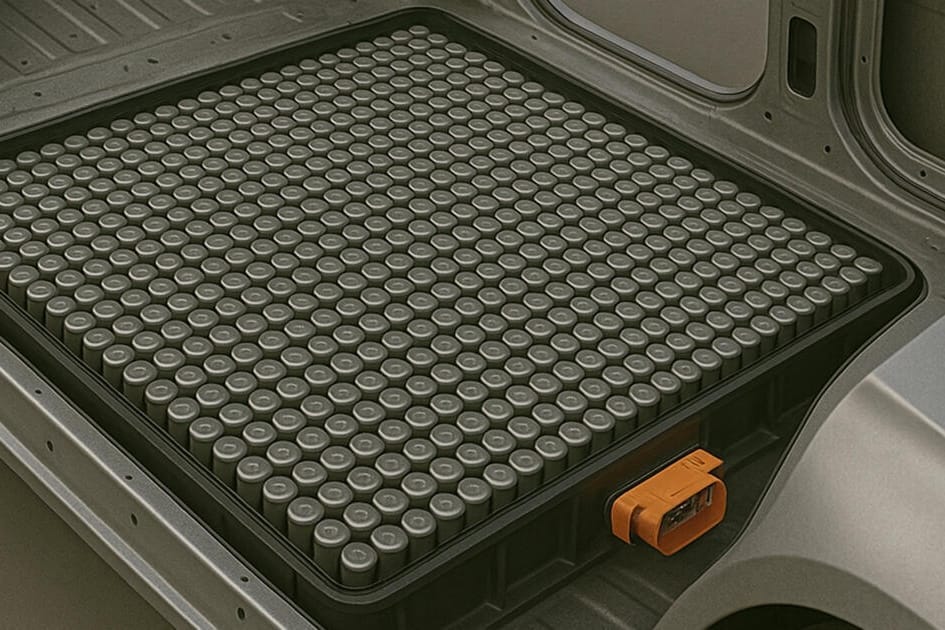
The research project is being funded by the EU with a total of around €6.2 million as part of the Horizon Europe programme. Project partners include Turkish electric car manufacturer Togg, chip manufacturer Infineon Austria and the Fraunhofer Institutes EMI and LBF.
The project is based on the idea of densely packing cylindrical cells in 4695 format into a lightweight housing using the cell-to-pack approach. The housing will be made from recycled fibre-reinforced thermoplastic materials. In other words, the protective housing will be made from plastic that can be moulded when heated and hardens again when cooled. “A cell holder structurally integrated into the housing makes it possible to completely dispense with casting materials,” says PEM director Prof. Achim Kampker.
This has the advantage of achieving a significantly higher energy density than has been possible to date. The planned concept targets an energy density of 220 Wh/kg at the pack level. “This is more than 14 per cent above the state of the art,” emphasised Kampker.
Thanks to combined indirect cooling solutions integrated into the cell holders of the housing, charging and discharging rates of more than 4.5 C are to be achieved. Fire safety is to be improved by a soft ventilation concept in conjunction with fire-retardant nanomaterials integrated into the cell holders.
The energy efficiency of the battery will also be increased. “The use of thermoplastic materials for the housing provides additional insulation for the battery pack, resulting in a longer service life in cold environments before active heating solutions are required,” said PEM management member Prof. Heiner Heimes.
The battery packs to be developed are intended to be suitable not only for electric vehicles, but also for electric aircraft in the future. Incidentally, the acronym RESiLiTE stands for Robust, Economical, Silicon-rich, Lightweight, and Thermally Efficient battery packs. The project is scheduled to run until June 2028.
Update 30.04.2026
The RESiLiTE project has recently received new battery cell samples. These test cells are intended to help refine the sensor and control mechanisms of the battery management system. According to those involved in the project, securing these samples represents a crucial milestone and serves as the basis for optimising battery charge and discharge cycles at high C-rates. This optimisation is intended to ensure efficient operation, protect the battery from damage and maintain its operational lifespan.
“The project is on track to achieve all its KPIs by developing a prototype that is ready for industrialisation,” comments Stefano Piacquadio, development engineer at project coordinator Kautex Textron. “Together with our partners, we are advancing the state of the art in battery pack technology, developing industrializable architectures with exceptional packaging efficiency, high C-rate capability and advanced diagnostics to support these innovations.”
pem.rwth-aachen.de, pem.rwth-aachen.de (RESiLiTE), europa.eu (Update)
This article was first published by Florian Treiß for electrive’s German edition.


0 Comments